Product Parameters
Operating frequency: 20kHz ~ 500kHz, suitable for high-frequency switching power supplies. Operating temperature: -40℃ ~ +125℃ (some models can reach +180℃). Storage conditions: -25℃ ~ +85℃, humidity 30% ~ 95% RH. Insulation withstand voltage: Usually requires AC 2000V, insulation resistance ≥200MΩ (tested at DC 500V).
* Features The ETD34 is a well-rounded and highly balanced medium-to-high power magnetic core. Building upon the excellent characteristics of the ETD29, it achieves a significant leap in power rating through a substantial increase in Ae and Aw, while maintaining good manufacturability and heat dissipation. When your project requires a reliable, efficient, and easy-to-manufacture power solution in the 150W to 250W range, the ETD34 is often one of the preferred options. * Typical application areas Industrial switching power supply:Standard industrial power modules ranging from 200W to 300W, and main power supplies for industrial control equipment. Communication/Network Equipment:Auxiliary power supplies for servers, built-in power supplies for high-end routers/switches, and power modules for communication base stations. Power electronics:Auxiliary power supplies and control power supplies for different power supplies, frequency converters, and servo drives. High-power LED driver:For commercial and industrial lighting with a power of 100W or more. Automobiles and charging equipment:Internal control power supply for on-board chargers and DC charging piles. Audio amplifier:Output filter inductors or power transformers used in high-power Class D audio amplifiers. * Product Standards UL, RoHS, 3C,CQC * Size Specifications 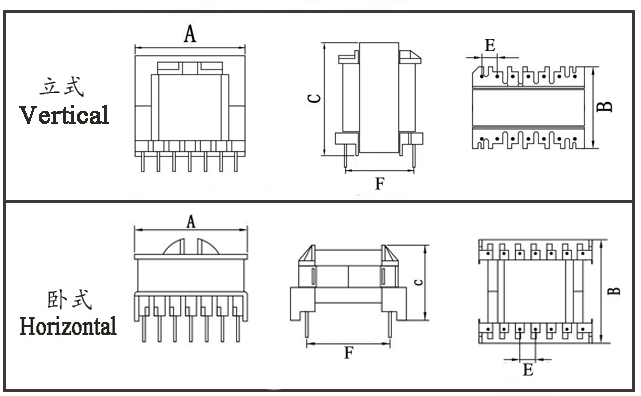
Type | Structure
Tурe | Dimension(mm) | Pin Row (mm) | Row Pitch
(mm) | OD Pin
(mm) | note | A | B | C | Pin | Pin Pitch | ETD34-001 | Vertical | 36.0 | 31.0 | 40.0 | 6+6 | 5.00 | 25.0 | Φ1.0 |
| ETD34-002 | Vertical | 43.0 | 32.0 | 41.0 | 8+8 | 5.00 | 25.2 | Φ1.0 |
| ETD34-003 | Horizontal | 41.0 | 41.0 | 31.5 | 7+7 | 5.00 | 25.5 | Φ1.0 |
| ETD34-004 | Horizontal | 41.0 | 41.0 | 30.0 | 15+15 | 2.54 | 30.0 | Φ0.8 |
| ETD34-005 | Horizontal | 43.5 | 38.0 | 30.0 | 16+16 | 2.50 | 25.5 | Φ0.8 |
| ETD34-006 | Horizontal | 41.0 | 41.0 | 30.0 | 16+16 | 2.54 | 30.0 | Φ0.6 |
|
*The above are commonly used skeleton styles for the company.,Other styles are not included.,Inquiries are welcome. Our company can customize high-frequency transformers of various specifications according to customer requirements.
ETD34 Transformer Performance Core Features and Structural Positioning Size Positioning: With a side length of 34mm, it belongs to the medium-to-high power category. The ETD34 is a highly popular model within the ETD series, striking an excellent balance between power density and manufacturability. Inherits Family Advantages: It fully retains the signature benefits of the ETD series: a circular center post (excellent winding manufacturability and high fill factor), a symmetrical magnetic circuit (low leakage inductance), and an outstanding thermal coupling structure (superior heat dissipation). Key Performance Parameters of ETD34 (Based on Common PC40 Material)
Center Post Diameter: Approx. 10.3 mm
Effective Cross-Sectional Area (Ae): Approx. 97.1 mm² (This is the key to its increased power handling, about 28% larger than the 76.0 mm² of the ETD29)
Window Area (Aw): Approx. 69.8 mm² (About 66% larger than the 42.0 mm² of the ETD29, providing space for more or thicker windings)
Volume (Ve): Approx. 7240 mm³
AL Value (ungapped): Approx. 2500 nH/N² (reference value, dependent on material and air gap)
Performance Analysis 1. Power Handling Capability (Significantly Enhanced) The ETD34 is a workhorse for the 100W to 250W+ power range. Specific power depends on topology and operating frequency:
Flyback Topology: Typically used for 100W ~ 150W compact designs.
Forward, Half-Bridge, Full-Bridge Topologies: Leveraging its larger Ae and Aw, it can reliably handle 200W ~ 300W or even higher power (with good thermal design and optimization).
Core Reasons for Power Enhancement:
Larger Ae: Allows handling a higher voltage-time product at the same flux density, or using fewer turns at the same power, reducing copper loss.
Substantially Larger Aw: Can accommodate thicker primary and secondary wires, significantly reducing DC resistance and copper loss. This is key to its ability to handle higher currents.
2. Electrical and Thermal Performance
Higher Efficiency Potential: Larger physical size means absolute losses (especially copper loss) can be lower at the same current and flux density. Combined with the low-leakage symmetrical magnetic circuit, it facilitates achieving >92% or even higher overall efficiency.
More Pronounced Thermal Management Advantage: Greater surface area and thermal capacity make its heat dissipation far superior to the ETD29. It can handle considerable power even with natural convection cooling, with temperature rise control being a key strength.
High-Frequency Suitability: Still an excellent choice for high-frequency design. However, note that at higher frequencies, increased volume leads to higher total core loss. For applications above 200kHz, materials like PC95 with lower high-frequency losses are recommended.
3. Design Flexibility
Ideal Platform for Multiple Outputs and Complex Windings: The spacious window area easily accommodates multiple secondary windings, shielding layers, auxiliary windings, etc., making it ideal for industrial power supplies requiring multiple regulated outputs.
High-Current Output Capability: Secondary windings can use multiple thick strands or copper foil, making it perfect for low-voltage, high-current output applications (e.g., 12V/20A).
Air Gap Adjustment: Like the ETD29, the circular center post facilitates precise grinding or gapping, suitable for high-power flyback, PFC inductors, and applications requiring specific inductance.
Summary of Advantages and Disadvantages Advantages:
Excellent Power-to-Size Ratio: Offers substantial power handling capability relative to its volume.
High Current-Carrying Capacity: Thanks to the large window area, it is an ideal choice for low-voltage, high-current outputs.
Outstanding Thermal Performance: Innate excellent thermal structure combined with larger size ensures high reliability.
Ample Design Margin: Provides engineers with sufficient Ae and Aw margins, facilitating optimized designs and meeting safety creepage/clearance distance requirements.
Mature Manufacturing Process: Well-established supply chain and high cost-effectiveness within its power range.
Disadvantages:
Volume and Weight: Clearly larger and heavier than the ETD29, unsuitable for ultra-thin or portable devices with strict size constraints.
Cost: The core and required copper material costs are higher than for smaller models.
High-Frequency Limitations: At very high frequencies, its larger size may lead to increased eddy current and hysteresis losses, requiring more careful material selection.
Core Characteristics of the ETD34 Transformer As a mainstream mid‑power model in the ETD family, the ETD34 exhibits distinctive and highly competitive features. Its design perfectly combines high‑power handling capability with engineering‑friendliness, making it a cornerstone in switching power supply design.
I. Structural and Physical Characteristics1. Iconic Circular Center Post
King of Winding Technology: Inheriting the essence of the ETD series, the cylindrical bobbin makes it extremely convenient to wind multiple parallel strands, Litz wire, or even copper foil. Its high window fill factor is especially suitable for high‑current designs.
Production Consistency: Enables smooth automated winding, ensuring high yield rates and making it an ideal choice for mass production.
2. Generous Window Area Compared to the ETD29, the ETD34 offers a significantly larger window area—one of its most important advantages. This allows it to:
Accommodate thicker wires to carry higher output currents.
Easily wind multiple complex windings along with complete shielding layers.
Meet stricter safety insulation distance requirements, enhancing reliability.
3. Excellent Thermal Architecture
The cylindrical coil provides a large contact area with the core, enabling short and efficient heat transfer from the interior to the exterior.
The core itself has a larger surface area and thermal capacity, giving it far superior heat dissipation compared to smaller cores. This results in lower temperature rise and higher long‑term reliability at the same power density.
II. Electrical Performance Characteristics1. Clear Power Positioning Optimized for mid‑to‑high‑power applications from 100W to 250W+. It serves as a benchmark choice for transitioning from “low‑power” to “industrial‑grade power” designs. 2. High Efficiency and Low‑Loss Potential
The large window area allows for low‑resistance windings, significantly reducing copper losses.
The symmetrical magnetic circuit effectively minimizes leakage inductance, reducing switching stress and EMI.
Combined with high‑quality core materials, it readily achieves >92% or higher conversion efficiency.
3. Strong Multi‑Output and High‑Current Capability Its spacious window makes it an excellent platform for designing multi‑output regulated power supplies (e.g., ±12V, 5V, 3.3V). It is a classic choice for low‑voltage, high‑current outputs such as 12V/20A or 5V/30A.
III. Design and Application Features1. Ample Design Margin When designing a 150W power supply with the ETD34, engineers enjoy a comfortable margin. The generous Ae and Aw allow optimizations—such as lowering flux density to reduce core loss or thickening wires to cut copper loss—resulting in more reliable and cooler‑running products. 2. Wide and Mature Application Base It has become one of the preferred cores for industrial‑standard power supplies, telecommunications power systems, and high‑power LED drivers in this power range. Its supply chain is mature, and pricing is competitive. 3. Versatile Suitability Beyond serving as a main transformer, it is also commonly used in mid‑to‑high‑power PFC boost inductors, as it can easily accommodate large air gaps and withstand substantial DC bias currents.
Typical Application Areas of ETD34 Transformer Leveraging its outstanding power capability, excellent thermal performance, and generous design margins, the ETD34 dominates multiple medium- to high-power fields that demand reliability and high performance. Overview of Core Application Areas for ETD34 The ETD34 is primarily positioned in the 100W to 300W power range, excelling particularly in 150W–250W applications. It serves as a cornerstone for industrial, telecommunications, and high-end consumer electronics power supplies.
I. Industrial Power and AutomationThis is the most extensive and classic application area for the ETD34.
Industrial Switching Power Modules:
Standard industrial power supplies: Open-frame or enclosed power supplies with outputs such as 24V/10A or 48V/5A (200W–300W), widely used in factory automation equipment, PLC systems, and robotic control cabinets.
Industrial PC and server power supplies: Built-in power units for mid-to-low-power workstations and industrial servers.
Motor Drives and Inverters:
Used as auxiliary and control power supplies inside servo drives and frequency inverters, providing multiple isolated voltages (e.g., ±15V, +5V, +24V) for control boards, drive circuits, fans, etc.
Test and Measurement Equipment:
Powers internal circuits in precision instruments like electronic loads, oscilloscopes, and spectrum analyzers. Their requirements for stability and low noise align well with the ETD34’s low leakage inductance characteristics.
II. Telecommunications and Network InfrastructureA field with extremely high demands for efficiency and reliability.
Telecom Base Stations / RF Units:
Converts -48V bus voltage into various low-voltage supplies for motherboards, power amplifiers, and cooling fans, requiring high power and environmental adaptability.
High-End Network Equipment:
Built-in power supplies for enterprise/data center-grade routers, switches, and firewalls, typically rated above 150W.
Fiber Optic Network Equipment:
III. Consumer Electronics and Computers (Medium-to-High Power Segment)
IV. New Energy and Power Electronics
Photovoltaic and Energy Storage Systems:
Electric Vehicle Charging Equipment:
Uninterruptible Power Supplies:
V. Lighting and Display
VI. Special Functional Applications
Key Reasons to Choose ETD34 for Your ApplicationThe ETD34 is an ideal choice when your project meets one or more of the following criteria:
Power Requirements: Clearly within the 150W–250W range (up to ~150W for flyback topology, ~300W for forward/bridge topologies).
Current Requirements: Need for low-voltage, high-current output (e.g., 12V/15A or higher).
Complexity Requirements: Design requires three or more regulated outputs with stringent cross-regulation demands.
Reliability Requirements: High expectations for low temperature rise, long-term stability, and environmental adaptability.
Industry Standards: The target industry (e.g., industrial/telecom power) commonly adopts the ETD34 for this power range, with mature supply chains and design expertise.
|


