* Product Parameters
Operating frequency:10kHz-500KHz Operating temperature:-40℃ to +125℃ Storage temperature:-25℃ to +85℃ Storage humidity:30 to 95%
* Features The core advantages of the EI22 high-frequency transformer can be summarized as follows:This 15–30W medium-power high-frequency adapter boasts double the power output while maintaining a compact size, high current carrying capacity, high efficiency and low loss, high insulation and strong compliance, low EMI immunity, and mature manufacturing process with high cost-effectiveness. While retaining the core advantages of the EI series in miniaturization and high-frequency compatibility, it achieves comprehensive improvements in power, current carrying capacity, stability, and compatibility.Advanced positioning is used for isolated power supply of medium-power high-frequency electronic devices.This benchmark model combines performance stability, mass production compatibility, and cost advantages, providing a high-performance, cost-effective core option for foreign trade support, product design, and large-scale production.
* Typical application areas Consumer electronics sector (core mainstream applications) Industrial control and sensing fields Smart Home and Internet of Things (IoT)IoT field LED lighting field Vehicle-mounted light equipment field Portable medical assistive devices
* Product Standards UL, RoHS, 3C,CQC * Size Specifications 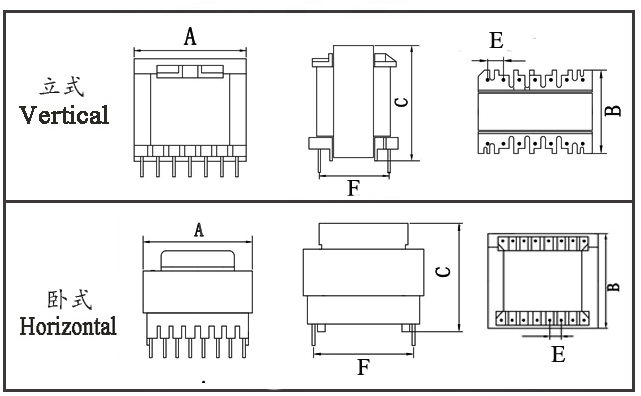
Type | Structure
Tурe | Dimension(mm) | Pin Row (mm) | Row Pitch(mm) | OD Pin
(mm) | note | A | B | C | Pin | E | F | EI22-001 | Vertical | 24.0 | 19.0 | 20.5 | 5+5 | 4.00 | 10.0 | Φ0.6 |
| EI22-002 | Horizontal | 24.0 | 25.5 | 18.5 | 8+8 | 2.50 | 15.0 | Φ0.6 |
|
*The above are commonly used skeleton styles for the company.,Other styles are not included.,Inquiries are welcome. Our company can customize high-frequency transformers of various specifications according to customer requirements.
EI22 High-Frequency Transformer Performance Analysis The EI22 high-frequency transformer is a core model for medium-power applications in the 10kHz-200kHz high-frequency range. Building upon the EI19, the EI22mm specification further enhances power handling and magnetic performance, covering the core 15–30W medium-power range. With customized high-stack versions capable of short-term overloads up to 35W, and leveraging a larger effective core area, low-loss high-frequency ferrite materials, and optimized magnetic circuit design, it features medium-power high capacity, low loss with high efficiency, high insulation and stability, and excellent EMC performance. It perfectly bridges the gap between the power ceiling of the EI19 and the bulkiness of larger EI25/EI28 models. It is a mainstream choice for high-frequency power supply in applications such as consumer electronics, industrial control, vehicle-mounted equipment, and medium-power LED drivers. The following provides a comprehensive performance analysis across six dimensions: core electrical performance, core and structural parameters, loss and temperature rise, insulation safety, electromagnetic compatibility (EMC), and process adaptability, meeting the needs of product design, selection, and technical consultations for international trade clients. I. Core Electrical Performance (Key Metrics for High-Frequency 10kHz–200kHz Operation)The electrical performance of the EI22 is optimized for the 15–30W medium-power range. It is suitable for high-frequency switching power supplies with single or multiple low-voltage, high-current outputs. Its design balances power handling, high-frequency stability, and energy efficiency, with core metrics comprehensively surpassing those of the EI13/EI16/EI19, making it a balanced benchmark for performance and mass-producibility in medium-power high-frequency transformers. II. Core and Key Structural Parameters (Performance Foundation, Industry-Standard Values)The EI22 utilizes manganese-zinc ferrite high-frequency cores. Compared to the EI19, both the effective cross-sectional area of the center leg and the window area are significantly increased, providing superior magnetic flux handling and winding layout space. This is the core foundation for its enhanced power capacity. The standard EI22 core parameters are industry-standard values, with customizable stack thickness, air gap, and bobbin pin configurations to meet different power and installation requirements.
Air Gap Customization and Performance Correlation In high-frequency applications, an air gap in the center leg is necessary to suppress DC bias saturation. The typical air gap range for the EI22 is 0.25–0.6mm, with the air gap size directly affecting inductance and anti-saturation capability. Customization is available for specific scenarios without additional cost:
Air gap 0.25–0.4mm: Higher inductance (primary inductance ≈ 300–500μH), suitable for low-current, high-inductance applications (e.g., industrial small-signal modules, precision sensor power supplies).
Air gap 0.45–0.6mm: Strong anti-saturation capability, suitable for high-current, multi-output applications (e.g., medium-power chargers, LED drivers), with slightly reduced inductance (primary inductance ≈ 150–300μH).
III. Loss and Temperature Rise Performance (Key Metrics for High-Frequency Operation, Excellent Controllability)Loss control is central to the high-frequency design of the EI22. Total losses consist of core losses (iron losses) and winding losses (copper losses). Thanks to its larger Ae area allowing for lower magnetic flux density design and optimized winding processes, losses are more evenly distributed, and temperature rise is well-controlled. Under normal conditions, no additional heat dissipation structures are needed; only simple heat dissipation designs are required for sealed applications to ensure long-term operation.
Core Losses (Iron Losses)
Primary Causes: Hysteresis and eddy current losses under high-frequency operation.
Loss Values: For PC40 core at 100kHz, iron loss ≈ 300–400mW/cm³; for PC44/TP4 low-loss cores at 100kHz, iron loss ≈ 240–320mW/cm³ (approximately 20% lower than PC40). TP4/TP5 materials are preferred for frequencies ≥150kHz.
Optimization Logic: The larger Ae reduces magnetic flux density by 15%–20% at equivalent power levels, lowering iron losses by about 18% compared to the EI19, and further shrinking the loss proportion.
Winding Losses (Copper Losses)
Primary Causes: DC resistance of windings and AC resistance due to high-frequency skin effect.
Loss Values: Under full-load conditions, copper loss ≤ 1.2W (at 30W rated power). Using 3–5 strands of fine copper wire in parallel winding can reduce skin effect, further lowering copper losses by 20%–25%.
Winding Impact: Layered close winding minimizes copper losses. Sandwich winding slightly increases copper losses (≤5%) but significantly reduces leakage inductance, balancing EMC performance.
Total Losses and Temperature Rise
Total Full-Load Losses: ≤1.8W (at 30W rated power), accounting for ≤6% of total power, placing its energy efficiency ratio at the forefront of medium-power high-frequency transformers.
Ambient Temperature Rise: Under normal 25°C conditions, full-load temperature rise is 25–38°C, well below the withstand temperature of the insulation class. Temperature rise ≤45°C in sealed scenarios.
Insulation Class: Standard Class B (130°C) and Class F (155°C), with optional Class H (180°C). Class F can operate in an ultra-wide temperature environment of -30°C to 95°C, meeting the temperature requirements of industrial, automotive, and outdoor applications.
IV. Insulation and Safety Performance (Core Compliance, Meets International Standards)The insulation design of the EI22 balances basic consumer-grade requirements with industrial/medical/vehicle-grade high-safety standards. Core metrics comply with international and domestic safety standards such as IEC 61558, UL 60950, GB 8898, EN 61347. Customized ultra-high withstand voltage versions are available, making it a benchmark for insulation safety in the medium-power range, suitable for multi-scenario high-safety needs. V. Electromagnetic Compatibility (EMC) – Low Leakage Inductance, Low Distributed Capacitance, Strong Anti-Interference CapabilityThe EMC performance of high-frequency transformers directly determines the electromagnetic interference level of the entire machine. Through structural optimization and process customization, the EI22 achieves precise control of leakage inductance and distributed capacitance. Its EMC performance far surpasses that of non-standard core transformers of the same power level, significantly reducing the design complexity, size, and cost of system-level EMC filters, and improving EMC certification success rates. VI. Process Adaptability and Performance Optimization (High Producibility, Flexible Customization)The EI22 is a highly mature model in the industry for medium-power high-frequency transformers, with well-established core and bobbin supply chains. Its winding processes are highly adaptable, with mass production yields ≥99%. It also supports personalized customization, enabling performance optimization without mold development costs, balancing production efficiency and scenario-specific adaptation to meet the customized needs of different industries. 1. Mainstream Winding Processes and Performance Adaptation (Selectable as Needed, No Extra Cost) Winding Process | Core Advantages | Typical Scenarios | Core Performance Indicators | Layered Close Winding | Low copper loss, simple process, low cost | Single output, cost-sensitive consumer electronics | Efficiency 94%–96%, Leakage ≤120μH | Sandwich Winding | Extremely low leakage, excellent EMC | Multi-output, industrial control, automotive, medical | Efficiency 92%–94%, Leakage 40–60μH | Multi-Strand Parallel Winding | Reduces skin effect, high current capacity | High-current output (≥5A), chargers, LED drivers | Copper loss reduced 20%, Efficiency +2-3% | Layered Segmented Winding | High inductance accuracy, parameter stability | Precision sensors, industrial small-signal modules | Inductance tolerance ±2%, Drift ≤±1% |
2. Core Directions for Performance Optimization (Small Cost Increase, Significant Performance Gain) Targeted optimization can be achieved in four dimensions based on different application needs, without changing the core model, offering strong adaptability:
Core Material Optimization: For f≥100kHz, choose PC44/TP4 (low loss); for 50–100kHz, choose PC40 (cost-performance balance); for automotive/ultra-wide temperature/outdoor, choose TP5/TP6 high-temperature ferrite.
Winding Detail Optimization: Use multi-strand parallel winding for high current; add double-layer copper foil shielding for high EMC; use sandwich winding for multi-output; use layered segmented winding for high-precision needs.
Heat Dissipation Process Optimization: Bobbins with high-density heat dissipation slots, windings impregnated with high-temperature thermally conductive varnish can reduce temperature rise by an additional 6–10°C, suitable for fully sealed, fanless harsh scenarios.
Insulation Process Optimization: For medical/automotive/outdoor scenarios, increase the number of insulation tape layers, raise withstand voltage to 4500VAC, and employ waterproof insulation processes to improve environmental adaptability.
Core Features of EI22 High-Frequency Transformer The EI22 high-frequency transformer is a benchmark model for medium-power applications in the 10kHz-200kHz high-frequency range. The EI22mm specification achieves comprehensive upgrades in power, current-carrying capacity, insulation, and EMC performance over the EI19, covering the core 15–30W medium-power range (custom high-stack versions can achieve up to 35W for short durations). Leveraging a larger effective magnetic core area, low-loss high-frequency ferrite material, and a mature manufacturing system, it integrates core features such as high power handling for medium loads, high-current output, high efficiency with low losses, high insulation for strong compliance, and low EMI with strong interference immunity. It perfectly addresses the market gap between "insufficient power of EI19" and "excessive volume and high cost of EI25/EI28," making it a cost-effective choice for high-frequency isolated power supply in consumer electronics, industrial control, vehicle-mounted equipment, LED medium-power drivers, and other applications. The following outlines its core features from six dimensions: structural, electrical, safety, electromagnetic compatibility, process, and adaptability, highlighting its performance advantages and differentiating characteristics in high-frequency operation, tailored for product manuals, international selection, and customer inquiries. I. Advanced Structural Upgrade: Doubled Power Handling While Maintaining Compact Installation EI22mm core, with an effective center column area of ≈60-65mm² and a window area of ≈95-100mm², represents an increase of approximately 40% and 25% respectively compared to the EI19. This provides significantly greater magnetic flux handling and winding layout space. The power rating upgrades from 5-20W to 15-30W, perfectly meeting medium-power, high-current output requirements. The design maintains miniaturization for medium-power applications. Standard 5+5/8+8 pin 94V0 flame-retardant bobbins are compatible with various board-integrated and space-constrained device scenarios, with no wasted volume. Magnetic path length is ≈38-40mm, featuring low magnetic reluctance and high magnetic energy conversion efficiency. The core and bobbin fit precisely. After varnish impregnation and curing at high temperatures, the structure is exceptionally robust. Inductance drift under vibration/drop conditions is ≤±1%, with parameter stability far superior to smaller EI series models. II. Optimal High-Frequency Characteristics: Low Loss, High Efficiency, and Strong Current-Carrying Capability Utilizes high-frequency manganese-zinc ferrite cores (PC40/PC44/TP4/TP5) with a room-temperature saturation flux density of 400-450mT. High-frequency core loss is excellently controlled; for PC44 cores, core loss is only 240-320mW/cm³ at 100kHz. At the same power level, core loss is reduced by approximately 18% compared to the EI19. Lower magnetic flux density design further reduces the proportion of loss. Full-load conversion efficiency is 92%–96%, with no-load loss ≤0.25W, meeting Level VI energy efficiency standards. For high-current scenarios, 3-5 strands of fine copper wire in parallel winding effectively reduces high-frequency skin effect, lowering copper loss by 20%-25% and increasing efficiency by an additional 2%-3%. Supports custom air gaps of 0.25–0.6mm for precise matching to different applications: small air gaps suit low-current, high-inductance precision power supply scenarios; large air gaps enhance resistance to DC bias magnetic saturation, meeting the demands of medium-power scenarios with high current and multiple outputs. Ensures full stability across all high-frequency operating conditions. Winding wire diameter range: 0.25-1.2mm. Primary rated current: 0.5-2.0A; Secondary rated current: 2.0-8.0A. Window utilization: 70%-75%, suitable for multi-strand parallel winding and multiple outputs. Current-carrying capacity is more than double that of smaller EI series. III. Comprehensive Insulation and Safety: High Compliance for Demanding Applications Leading basic insulation specifications: primary-secondary withstand voltage 3000–4000VAC/1min; insulation resistance ≥400MΩ (500VDC), maintaining ≥100MΩ under high temperature and humidity (85℃/85% RH); creepage distance/clearance ≥4.0mm. This fundamentally prevents risks of high-voltage creepage and surface discharge. Insulation classes cover B (130℃)/F (155℃)/H (180℃). F-class can operate in an ultra-wide temperature range of -30℃~95℃; H-class meets high-temperature industrial/vehicle-mounted application demands. Multiple layers of insulation isolation between windings, core, and pins ensure no aging or leakage hazards during long-term use. Full process complies with international/domestic standards such as IEC 61558, UL 60950, GB 8898, RoHS/REACH/CE. Features lead-free, tin-plated environmentally friendly processes, adapting to global market exports. No additional environmental or safety certifications needed, enabling efficient and convenient integration for international trade. IV. Excellent Electromagnetic Compatibility: Low Interference, Reducing Overall Design Cost Precise control of leakage inductance and distributed capacitance. With standard layered close winding, primary leakage inductance ≤120μH, which can be reduced to 40–60μH with sandwich winding. Primary-secondary distributed capacitance ≤120pF, reduced to ≤70pF with the addition of a double-layer copper shield. This significantly reduces voltage spikes in high-frequency switching transistors and stray signal coupling, lowering EMI radiation and conducted interference. Features dedicated EMC optimization processes: a double-layer grounded copper shield (insulated with tape) between primary and secondary windings suppresses over 90% of high-frequency radiation interference. Arranging the low-voltage secondary winding closer to the core further reduces electromagnetic radiation from the high-voltage side and inter-winding distributed capacitance. Low leakage inductance and low distributed capacitance significantly reduce the design difficulty, size, and cost of the main unit's EMC filter, improving EMC certification pass rates. Perfectly suited for communication equipment, precision industrial control, medical auxiliary equipment, and other applications sensitive to electromagnetic interference. V. Flexible, Adaptive Manufacturing: High Production Readiness, Customization Without Extra Cost Supports a full range of winding processes—layered close winding/sandwich winding/multi-strand parallel winding/layered sectional winding—available on demand with no extra cost: Layered close winding offers low cost and low copper loss; Sandwich winding provides low leakage and superior EMC; Multi-strand parallel winding enhances current-carrying capacity; Layered sectional winding offers inductance accuracy of ±2%, suitable for precision power supply. Exceptionally high industry maturity, with a well-established supply chain for cores and bobbins. Mass production yield ≥99%. Supports customized needs such as pin bending/tinning, double-layer shield design, ultra-high withstand voltage customization, waterproof insulation processes, etc., without requiring mold development. Balances mass production efficiency with precise adaptation for specific scenarios. Outstanding mechanical safety performance: bobbin pin pull strength ≥8N. Core undergoes high-temperature varnish impregnation and curing. After assembly, there is no loosening or cracking, resistant to harsh conditions like industrial vibration, vehicle-mounted jolts, and outdoor drops. Adaptable to complex usage environments across multiple scenarios. VI. Precise Power and Scenario Adaptation: Outstanding Cost-Effectiveness with Clear Boundaries The ideal choice in the medium-power, high-frequency segment. It perfectly bridges the gap between the upper power limit of the EI19 and the volume/cost considerations of larger transformers. Within the 15-30W range, different power needs can be met simply by adjusting the stack thickness (12/15/20/25mm) without changing the core model, greatly simplifying product design and mass production processes. Extremely wide applicability, covering consumer electronics, industrial control, smart home, LED medium-power drivers, vehicle-mounted light loads, medical auxiliary equipment, and more. Addresses diverse needs such as board integration, high-current driving, wide-temperature operation, and precision power supply, offering a one-stop solution for medium-power, high-frequency power supply. Excellent loss and temperature rise control: full-load total loss ≤1.8W (at 30W rated power). Temperature rise at 25℃ ambient is only 25–38℃. Under normal operating conditions, no additional heat dissipation structure is required. In sealed environments, only simple heat dissipation design is needed to meet long-term operational needs. Limitations are clearly defined: it is a dedicated high-frequency model. At 50/60Hz power frequency, power is only 12-18W with efficiency <65%—strictly prohibited for power frequency use. The upper power limit is 30W (continuous operation). For applications >30W, the EI25/EI28 series is recommended to avoid drastic loss increase and excessive temperature rise affecting equipment lifespan. Summary of Core Features
Core Applications of EI22 High-Frequency Transformer The EI22 high-frequency transformer is designed for 15–30W medium-power, 10kHz–200kHz high-frequency power supply scenarios, serving as the benchmark model in the medium-power high-frequency segment. Leveraging its core characteristics of medium-power high load capacity, high-current output, high insulation and interference resistance, wide temperature adaptability, and low loss with high efficiency, it perfectly bridges the gap between the power ceiling of EI19 and the volume/cost inefficiencies of larger EI25/EI28 models. It is ideally suited for high-frequency switching power supply applications requiring electrical isolation, high-current drive, compact space, and wide-temperature operation. Widely applicable across consumer electronics, industrial control, vehicle-mounted equipment, medium-power LED drivers, smart homes, and more, it is a cost-effective medium-power choice for export supply chains and mass production. The following details are structured by application field, specific scenario, core adaptation advantages, and selection key points, tailored for product matching, customer selection, and practical needs in international trade. I. Consumer Electronics (Core Mainstream Application) Adaptable to various medium-power portable/household digital devices, solving the pain point of insufficient power from EI19 models. This is the most core application for EI22, featuring mature supply chains and low integration costs, covering all mid-to-high-end consumer product categories.
Medium-Power Compact Fast Chargers/Adapters: 15–30W compact fast charging bricks (for tablets, portable laptops, Pro-level handheld gimbals, flagship sports cameras, fast-charge versions of Bluetooth earphone charging cases), dedicated power adapters for digital devices. Advantages: Strong power handling while maintaining compact volume; supports 85–265VAC global wide voltage input; no-load loss ≤0.25W meets Level VI energy efficiency; can be integrated into compact charger housings, fitting portable and fast-charging design trends.
Medium-Power Audio/Video & Entertainment Devices: Power supply/isolation modules for portable Bluetooth speakers (high-volume models), mini projectors, handheld gaming consoles (high-performance models), portable live-streaming audio interfaces. Advantages: High-current output matches high power consumption of devices; robust structure resists vibration; low distributed capacitance eliminates audio/signal interference; tinned pins ensure high solder joint reliability; suitable for outdoor and mobile use scenarios.
Medium-Power Network Communication Terminals: On-board power modules for enterprise gigabit routers, multi-port optical network terminals (ONTs), household smart set-top boxes (4K HD models), flagship portable Wi-Fi devices. Advantages: Adaptable to various PCB mounting methods; strong anti-interference capability reduces high-frequency signal crosstalk impacting communication; low temperature rise eliminates need for extra heat sinks; capable of stable 24/7 long-term operation, meeting power demands for high data transmission.
II. Industrial Control & Sensor Field Suited for medium-power auxiliary power/signal isolation/high-current drive in industrial equipment. Primarily meets stringent industrial requirements for high insulation, interference resistance, ultra-wide temperature range, and parameter stability. A mainstream choice for medium-power high-frequency power in industry.
Medium-Power Industrial Sensors/Transmitters: Power modules for high-precision pressure sensors, temperature/humidity transmitters, laser distance measurement modules (medium-range models), industrial proximity switches (high-current models). Advantages: Excellent electrical isolation; ±2% inductance accuracy; resists strong electromagnetic interference in industrial settings ensuring measurement accuracy; adaptable to industrial ultra-wide temperature environments of -30℃~95℃.
Small Industrial Control Modules/Actuators: Auxiliary power for compact PLCs (medium-power models), industrial signal amplifiers, small relays (high-current drive models), industrial touchscreens. Advantages: 4000VAC high withstand voltage; F/H class insulation withstands industrial grid voltage fluctuations and surges; core varnish impregnation ensures ultra-stable structure, no loosening under vibration/jolts, enhancing equipment durability.
Portable Industrial Testing Equipment: On-board power for handheld thickness gauges (high-precision models), portable metal detectors, compact water quality testers (multi-parameter models), industrial endoscopes. Advantages: Compact size fits handheld designs; full-load temperature rise only 25–38℃, no extra heat dissipation needed; meets power needs for prolonged outdoor/on-site operation.
III. LED Lighting Field Suitable for 15–30W medium-power compact LED driver power supplies. Focuses on high efficiency, high insulation, and precise power matching. Replaces traditional line-frequency transformers for miniaturized, high-efficiency designs. Covers indoor, commercial, and outdoor portable lighting.
Indoor Medium-Power LED Lighting: Medium-power drivers for bedroom ceiling lights, living room downlights, cabinet lights (high-power models), vanity mirror lights (high-brightness models). Advantages: Over 92% efficiency significantly reduces energy consumption; integrates with driver board for compact design; 3000VAC withstand voltage ensures indoor electrical safety; flicker-free operation improves lighting experience.
Commercial Compact LED Lighting: Driver modules for small shop LED light boxes, display cabinet LED strips (high-brightness models), office area LED panel lights. Advantages: Strong long-term operational stability; adapts to high frequency; flicker-free suitable for prolonged commercial use; insulation safety meets commercial electrical standards; adapts to multi-lamp parallel power supply.
Outdoor/Portable LED Lighting: On-board power modules for rechargeable high-power flashlights, camping lights (high-brightness models), emergency lights (medium-power models). Advantages: Low no-load loss extends battery life; robust structure withstands drops/vibration; adaptable to complex outdoor environments; high-current output ensures brightness and runtime balance.
IV. Vehicle-Mounted Light-Load Device Field Suitable for medium-power compact electronic devices in 12/24/72VDC vehicle electrical systems. Core requirements are vibration resistance, high-temperature tolerance, wide-voltage input adaptation, and high insulation for vehicle-specific conditions. An optimal choice for medium-power high-frequency vehicle power.
Vehicle-Mounted Medium-Power Charging/Communication Devices: Auxiliary power modules for 15–30W vehicle fast chargers/adapters, vehicle Bluetooth speakers (high-volume models), compact dash cams (4K HD models), vehicle navigation systems. Advantages: Adapts to 12/24/72VDC wide voltage; F-class insulation tolerates high temperatures (≤95℃); withstands vehicle environment heat, minor vibrations, jolts; reliable soldering resists detachment; suitable for complex vehicle power environments.
Vehicle-Mounted Compact Smart Devices: Power modules for vehicle mini air purifiers (high-power models), tire pressure monitor displays (multi-function models), vehicle aroma diffusers (heated models). Advantages: Compact size saves vehicle interior space; anti-electromagnetic interference prevents device malfunction from vehicle grid noise/engine EMI, ensuring safe usage while driving.
V. Smart Home & Internet of Things (IoT) Field Suitable for various medium-power smart terminals/high-current drive smart devices. Core requirements are low standby power, high-current drive capability, and wireless communication interference resistance. Perfectly matches medium-power loads like motors, cameras, and HD displays in smart homes.
Medium-Power Smart Control/Drive Devices: Power modules for smart curtain motors (high-power models), home smart cameras (4K HD models), human infrared sensor controllers (high-current drive models), smart locks (with large screen). Advantages: Low no-load loss suits device sleep modes; high-current output drives motors/large screens; strong anti-interference does not affect WiFi/Bluetooth/ZigBee signals, ensuring accurate device联动 (linkage).
Medium-Power Compact Smart Appliances: High-frequency power modules for small humidifiers (high-mist output models), desktop air purifiers (high-efficiency models), compact electric heating cups (high-power models), mini smart blenders. Advantages: Wide-voltage input adaptation; safe insulation; can be directly integrated into appliance control boards; compact size saves internal space; high energy efficiency reduces appliance consumption.
IoT Medium-Power Data Acquisition Devices: Power modules for wireless data collectors (multi-channel models), IoT gateways (medium-power models), smart temperature/humidity monitors (with large screen). Advantages: High-frequency(characteristics) match wireless module operating frequencies; parameter drift ≤±1% ensures continuous data acquisition/transmission in complex home environments; suitable for whole-house smart home and remote control scenarios.
VI. Portable Medical Auxiliary Equipment Field Suitable for non-invasive medium-power portable medical auxiliary devices. Core requirements are high safety, high insulation, low EMI, and parameter stability, complying with medical equipment safety standards. Only for auxiliary power, not for core power in large medical devices.
Medium-Power Portable Medical Devices: Power modules for electronic blood pressure monitors (large screen models), blood glucose meters (with print function), compact nebulizers (high-power models), handheld massagers (multi-intensity models). Advantages: 4000VAC medical-grade high withstand voltage; low electromagnetic interference avoids impact on device measurement accuracy from high-frequency signals; lead-free tinning meets environmental/medical requirements; compact size fits portable design.
Medical Consumable Accessories: On-board power for disposable infusion alarms (high-current models), compact pulse oximeters (large screen models), medical mini indicator lights (high-brightness models). Advantages: Small size integrates into device housing; reliable soldering and high insulation(class) ensure safety in medical scenarios; fits miniaturization/portability trends in medical devices.
VII. Other Medium-Power Portable Fields
Medium-Power Small Toy Electronics: Power modules for smart RC cars (high-performance models), electric building blocks (high-power models), mini robots (multi-action models), RC planes (large-size models). Advantages: Low cost, mature process, high (mass production suitability) fits toy industry scale production; high-current output ensures proper operation of toy motors/action modules.
Portable Energy Storage Devices: On-board isolation modules for 15–30W power bank fast-charge modules, compact portable power banks (medium-power models), outdoor mobile power banks (mini models). Advantages: Low loss improves energy storage utilization; high insulation ensures safety; compact size integrates into storage device interior; suitable for portable energy storage/outdoor power supply.
Office Medium-Power Compact Devices: Power modules for mini thermal printers (high-speed models), handheld barcode scanners (wireless models), office time clocks (with large screen), small paper shredders (compact models). Advantages: Adapts to low-power office needs; strong long-term operational stability, low maintenance; high energy efficiency reduces office energy consumption, improving device efficiency.
|


