* Product Parameters Operating frequency:10kHz-500KHz Operating temperature:-40℃ to +125℃ Storage temperature: Storage humidity:30 to 95%
* Features
The ER20 is the most mature and widely used ER transformer in the 10-18W range. It has sufficient power, low leakage inductance, high withstand voltage, good heat dissipation, multiple outputs, and stable mass production.
* Typical application areas The ER20 is the preferred model for small to medium power isolated power supplies ranging from 10 to 18W. Covering all scenarios including power supply, industrial control, communication, lighting, home appliances, and automotive, It is the most widely used and most mature medium-power ER transformer in the industry. * Product Standards UL, RoHS, 3C,CQC * Size Specifications 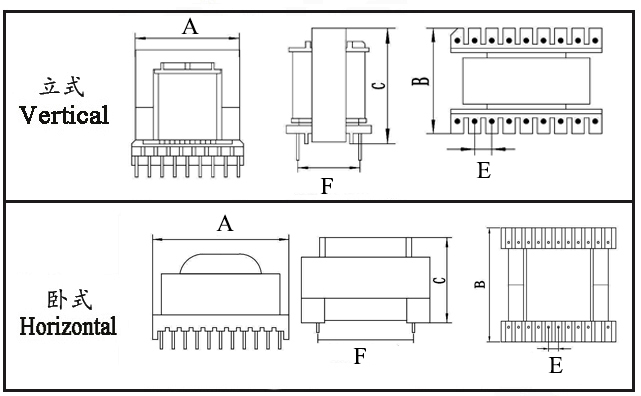
Type | Structure
Tурe | Dimension(mm) | Pin Row (mm) | Row Pitch(mm) | OD Pin
(mm) | note | A | B | C | Pin | E | F | ER20-001 | Vertical | 20.5 | 14.5 | 8.5 | 5+5 | 2.50 | 16.50 | SQ0.5*0.5 | SMD | ER20-002 | Vertical | 20.5 | 14.5 | 8.5 | 5+5 | 2.50 | 24.80 | SQ0.5*0.5 | SMD | ER20-003 | Vertical | 20.5 | 14.5 | 8.5 | 3+2 | 3.2/5.0 | 15.00 | SQ0.5*0.5 |
|
*The above are commonly used skeleton styles for the company.,Other styles are not included.,Inquiries are welcome. Our company can customize high-frequency transformers of various specifications according to customer requirements.
Performance of ER20 Transformer
Core Concept of ER20
ER Core: ER stands for E-Round, a variant of the E-I core with a cylindrical center leg instead of a square one. This design facilitates easier winding, reduces leakage flux, and typically offers superior high-frequency performance compared to traditional E-type cores.
The ER core series follows standardized size codes, such as ER9.5, ER11, ER14.5, ER20, ER25, ER35, etc.
Electrical Performance Excellent High-Frequency Characteristics:
Low Loss: ER cores (commonly made of materials like PC40, PC44, PC95) are designed for high-frequency switching power supplies. They exhibit low core loss (iron loss) within the frequency range of tens to hundreds of kHz. The cylindrical center leg ensures more uniform flux distribution, further reducing losses.
Low Leakage Inductance: The primary and secondary windings can be more tightly coupled on the cylindrical center leg, making it easier to achieve low leakage inductance compared to square center legs. This is critical for improving efficiency and reducing switching stress (e.g., RCD snubber losses in flyback topologies).
Lower Winding Capacitance: The structure allows for more optimized winding layouts, helping to balance leakage inductance and distributed capacitance.
Power Handling Capability: The power capacity of the transformer depends on the core’s effective cross-sectional area (Ae), window area (Aw), operating frequency, and allowable temperature rise. For ER cores with a size code around 20mm (e.g., ER11/14.5), the typical power range is from a few watts to about 20–30 watts. These are commonly used in low-power switch-mode power supplies (SMPS). Flexibility: Can be designed for various topologies, such as Flyback, Forward, LLC resonant, etc. In low-power applications, flyback topologies are the most common.
Thermal Performance
Good Heat Dissipation: ER cores have a relatively large contact surface area and are typically paired with plastic bobbins. The exposed parts of the core can directly contact air or dissipate heat through thermal materials to the casing, aiding in heat dissipation.
Controllable Temperature Rise: High-quality core materials and low-loss designs ensure low temperature rise under rated power operation.
Mechanical and Structural Performance
Easy Winding: The cylindrical bobbin has no sharp edges, allowing smoother winding with winding machines and reducing damage to enameled wires. This is particularly beneficial for automated production.
High Consistency: Standardized cores and bobbins ensure parameter consistency in mass production.
Sturdy Structure: When paired with bobbins and clips, the core assembly is robust and resistant to mechanical vibrations.
Characteristics of the ER20 Transformer 1. Structural Characteristics
Cylindrical Center Leg: This is the most distinctive feature of the ER core. Compared to traditional square center legs (e.g., EE cores), the cylindrical structure has no sharp edges.
Advantages:
Enameled wires experience uniform stress during winding, reducing the risk of insulation damage or pressure points. This makes it particularly suitable for high-speed automated winding machines, ensuring consistency.
The circular cross-section shortens the average length per turn, helping to reduce the DC resistance of the winding and thereby lowering copper losses.
Compact Physical Size: As a miniaturized transformer, it is ideal for modern electronic devices with limited space.
Standardized Bobbin and Core: Comes with a matching plastic bobbin featuring clearly defined pin positions, facilitating easy PCB installation (typically horizontal mounting).
2. Electrical Performance Characteristics
Excellent High-Frequency Performance:
Low Core Loss: Typically made from high-frequency power ferrite materials (e.g., TDK's PC40/PC44 or more advanced PC95). Combined with the uniform magnetic flux distribution provided by the cylindrical center leg, core losses are significantly lower than traditional cores at operating frequencies ranging from tens to hundreds of kHz.
Low Leakage Inductance: The primary and secondary windings can be tightly and symmetrically wound around the cylindrical center leg, enabling better coupling and lower leakage inductance. This is key to improving flyback power supply efficiency and reducing switching transistor voltage stress.
Lower Distributed Capacitance: The structure allows easier optimization of winding layouts (e.g., through layering or slot winding) to balance the relationship between leakage inductance and distributed capacitance.
Moderate Power Range: Its typical power handling capacity generally ranges from 10W to 18W, depending on factors such as:
The core's effective cross-sectional area.
Operating frequency (higher frequencies theoretically allow greater power transmission).
Insulation class and cooling conditions.
Good Thermal Performance:
Heat is dissipated from the core and windings via the bobbin, and the core's large exposed surface area facilitates natural cooling.
Low-loss designs reduce heat generation at the source, resulting in lower temperature rise under rated conditions and ensuring stable, reliable operation.
3. Application and Process Characteristics
Primary Application Topology: Most suitable for single-ended flyback switching power supply topologies. This is due to its simple design, efficient implementation of multi-output and electrical isolation, and its perfect match for this power range. It can also be used in low-power forward converters or auxiliary power supplies.
High Adaptability to Automated Production: The entire production process, from winding and wire arrangement to assembly, is easily automated, ensuring product consistency and reliability, making it ideal for mass manufacturing.
High Power Density: Enables efficient energy transfer, aligning with the modern trend of "miniaturization and high efficiency" in power supplies.
ER20 Transformer Application Scenarios I. Suitable Positioning
Power: 10W–18W
Structure: ER circular center leg, low leakage inductance, high isolation
External Spacing A: 20mm
Suitable for: Medium and small power isolated power supplies, main power supplies, auxiliary power supplies, multi-output supplies.
II. Main Application Areas
Switching Power Supplies & Adapters
Main power transformer for power adapters.
Chargers, fast chargers, LED driver power supplies.
Industrial low-power switching power supplies.
Features: Sufficient power, high isolation, good EMI performance, high efficiency.
Industrial Control & Industrial Power Supplies
Main/auxiliary power for PLCs, industrial control boards, drive modules.
Control power for inverters, servo drives, welding machines.
Isolated power supply for instruments, sensors, transmitters.
Features: Wide temperature range, high reliability, strong anti-interference.
Communication & Networking Equipment
Routers, switches, optical network terminals (ONTs), 5G small cells.
PoE (Power over Ethernet) modules, DTU data transmission devices.
Features: Low noise, good isolation, minimal signal interference.
Lighting & LED Drivers
Drivers for high-power LED downlights, panel lights, industrial and mining lights.
Smart lighting, plant growth light power supplies.
Features: Stable for long-term operation, low temperature rise.
Household Appliances & Consumer Electronics
Small appliances, smart home appliances, audio equipment.
Projectors, set-top boxes, security devices.
Features: Safety standard compliant, high withstand voltage, long lifespan.
Automotive Electronics (Can be made to Automotive Grade)
Vehicle power supplies, automotive lighting drivers, body control modules.
Compliant with: Wide temperature range (-40℃ to 125℃), high reliability.
III. Core Application Advantages of ER20
Most common and versatile main model for 10–18W.
Capable of multi-output, high current, reinforced insulation.
Low leakage inductance, easy to pass EMI certification.
Isolation withstand voltage up to 3kV AC.
Good heat dissipation, suitable for continuous full-load operation.
|


