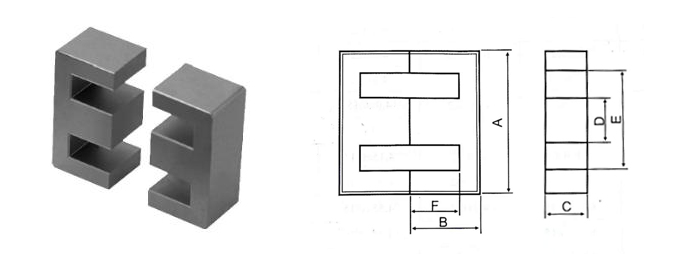
* Product Parameters
Operating frequency: 10kHz-500KHz Operating temperature: -40℃ to +125℃ Storage temperature: -25℃ to +85℃ Storage humidity: 30 to 95%
* Features It features high operating frequency, high efficiency, small size, and light weight.
* Typical application areas This transformer is a prime example of "small size, big challenge," used for...Extremely sensitive to size and weight Occasions: Ultra-thin/micro USB isolation module: used for signal isolation or low-power isolated power supply. Inside the charger for smart wearable devices: It provides isolated auxiliary power to the control circuitry. Auxiliary power supply for high-performance, high-density digital isolation chips. Sensors in portable medical devices are powered in an isolated manner (such as blood oxygen probes). Onboard miniature isolated DC-DC converters for IC test fixtures and precision measurement equipment.
* Product Standards UL, RoHS, 3C,CQC * Size Specifications 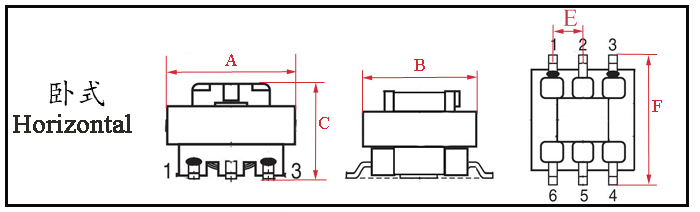
Type | Structure
Tурe | Dimension
mm | Pin Row
mm | Row Pitch(mm) | OD Pin
mm | note | A | B | C | Pin | E | F | EE05-001 | Horizontal | 6.0 | 5.2 | 5.0 | 3+3 | 1.85 | 7.70 | SQ0.20*0.55 | SMD | EE05-002 | Horizontal | 6.0 | 5.5 | 5.0 | 3+3 | 1.85 | 7.70 | SQ0.20*0.55 | SMD- 2 Slots |
*The above are commonly used skeleton styles for the company.,Other styles are not included.,Inquiries are welcome. Our company can customize various specifications according to customer requirements.High-frequency transformer.
EE5.0 Transformer. This is a very specific and common small-size model. The following provides a detailed analysis of its electrical parameters, design key points, and application limitations specifically for this core size. I. Core Characteristics & Physical Dimensions
Core Size Code: Typically refers to a core with a "leg-to-leg" length (A dimension) of 5mm. This is a miniature core.
Typical Full Dimensions: A common specific part number is EE5.3/5.2/2.1 or a similar variant, interpreted as follows:
Bobbin Pin: Usually a 3+3 pin configuration (6 pins total), with a pin pitch often 1.25mm or 1.27mm, making it a very fine-pitch SMD component.
II. Detailed Key Electrical Parameters (Based on Typical Datasheets) Due to minor variations between core manufacturers (e.g., TDK, FDK, TianTong, etc.), the following parameters are typical ranges. The official datasheet for the specific selected part must be the primary reference during design. 1. Core Geometric Parameters (Design Basis) Parameter | Symbol | Typical Value | Unit | Notes & Impact | Effective Cross-Sectional Area | Ae | 2.5 - 3.5 | mm² | This is one of the most critical constraints for such cores. A small value means more turns or higher frequency is needed to transfer the same power. | Effective Magnetic Path Length | Le | 12-15 | mm | Together with Ae, it determines the effective volume. | Effective Volume | Ve | 30 - 50 | mm³ | Extremely small, directly limiting its power handling capability. Typically used for ultra-low power scenarios below 1W. | Window Area | Aw | 3-5 | mm² | The available space for winding is very limited, constraining wire gauge and number of turns. Another key limitation. | Area Product | AP | ~10 | mm⁴ | (Ae * Aw). An index for quick estimation of power capability; the value is extremely small. |
2. Electrical & Performance Parameters (Design Goals & Constraints)Parameter | Symbol | Typical Range / Consideration | Units / Notes | Typical Power Range | Pout | 0.1W - 1.5W | Conservative range for continuous operation in efficient flyback or isolated BUCK-BOOST topologies. Slightly higher for peak or intermittent operation. | Operating Frequency | f | 100kHz - 1MHz | Due to its very small Ae, high frequency is mandatory to reduce required turns for power transfer. Commonly used at 200kHz-500kHz. | Primary Inductance | Lp | Tens to hundreds of µH | Specific value determined by input voltage, frequency, and power. E.g., for 5V input, 500kHz, 0.5W output, Lp might be in the 100- 200µH range. | Saturation Current | Isat | Tens to hundreds of mA | Determined by Ae, number of turns, and core material Bsat. Very small; peak current must be calculated precisely in design to prevent saturation. | Typical Turns Ratio | Np:Ns | Based on input/output | E.g., converting 3.3V/5V to isolated 3.3V/5V, or for low-power auxiliary supplies. Common ratios like 1:1, 1:2, 2:1, etc. | Insulation Withstand Voltage | - | 1500VAC - 3000VAC/min | Due to its tiny volume, insulation processing is challenging, but basic safety standard requirements must still be met. Depends on insulation method (triple insulated wire, tape, barriers, etc.). | Typical Application Topology | - | Flyback, Single Transistor BUCK-BOOST | Almost exclusively used for isolated, low-power DC-DC conversion. |
III. Design Challenges & Core Considerations
Power Limit: Ve and Aw are hard constraints. The calculated maximum transferable power (via AP or Kg method) is extremely limited. Forcing higher power leads to severe heating and drastic efficiency drop.
Winding Process is Key:
Extremely Fine Wire: Due to the small window, wire gauges like AWG 38 to AWG 44 (diameter 0.1mm - 0.05mm) or finer are typical. Wires break easily during winding.
Turn Limitation: Even with fine wire, the number of turns is limited by Aw. This, in turn, requires using high-permeability core material or higher ΔB, but saturation must be avoided.
Interlayer Insulation: Achieving reliable insulation and tape wrapping between windings (especially primary-secondary) within the tiny space is critical for meeting withstand voltage and safety standards, and is a major manufacturing difficulty.
High Frequency & Losses:
High-Frequency Operation is a Must: This is a prerequisite for using such miniature cores.
Core Loss: At high frequencies, even with small ΔB, core loss (proportional to f^α * B^β) can become a primary heat source. Low-loss, high-frequency materials like PC95, PC47, etc., are required.
Copper Loss & Skin Effect: Copper loss increases at high frequency, but is usually not the main concern due to the very small currents.
Air Gap & AL Value: A tiny air gap is often ground into the center leg. Its AL value is very low (perhaps only tens of nH/N²), requiring precise turns to achieve the target inductance Lp.
IV. Typical Application Scenarios This transformer exemplifies "small size, big challenge," used in applications with extreme sensitivity to size and weight:
Ultra-thin/Micro USB Isolation Modules: For signal isolation or low-power isolated power supply.
Inside Smart Wearable Device Chargers: Providing isolated auxiliary power for control circuits.
Auxiliary Power for High-Performance, High-Density Digital Isolator Chips.
Isolated Sensor Power Supply in Portable Medical Equipment (e.g., pulse oximeter probes).
On-Board Miniature Isolated DC-DC for IC Test Fixtures, Precision Measurement Equipment.
Conclusion & Selection Advice
Clear Positioning: The EE5 with A dimension of 5mm is a miniature core for sub-watt to 2-watt levels, not a general-purpose power device.
Design Keys:
The primary task is to obtain the exact Datasheet and confirm core geometric parameters: Ae, Le, Ve, Aw, etc.
Next, select appropriate high-frequency, low-loss core material (prioritize materials like PC95, PC44 over PC40).
Then perform rigorous calculations for turns, wire gauge, current density, losses, and temperature rise to ensure operation within safe limits.
Strong Recommendation: For such miniature transformers, unless you have special winding capabilities and test equipment, prioritize purchasing standardized off-the-shelf products from professional manufacturers (e.g., Coilcraft, Würth Elektronik, Pulse, etc.). They provide complete electrical parameters (Lp, Lk, DCR, Isat, Withstand Voltage, etc.) and typical application curves, significantly reducing design risk and manufacturing difficulty.
In a nutshell: This is a "precision micropower" magnetic component for extremely compact spaces. Its design focus shifts more from "power transfer" to "achieving reliable signal/energy isolation under extreme constraints."
The EE5 series transformer is one of the most classic and widely used standard components in modern switching power supplies. Its characteristics can be summarized from four dimensions: structure, performance, application, and economics. It has distinct advantages and disadvantages, with a clear and well-defined positioning. Summary of Core Features of EE5 Transformers I. Structural Design Features
Standardized, Modular Design: The E-shaped core and its matching plastic bobbin are highly standardized, with uniform dimensions and pin arrangements, facilitating automated production and SMT mounting. They are essentially the "LEGO bricks" of the electronics manufacturing industry.
Symmetrical E-Core Structure: The magnetic path exhibits good symmetry, resulting in relatively low leakage inductance and minimal magnetic field dispersion, which is beneficial for electromagnetic compatibility (EMC).
Adjustable Center Leg Gap: By grinding or inserting a gap material at the center leg, the inductance factor (AL value) can be precisely adjusted. This allows flexible adaptation to different circuit requirements for primary inductance, making it an ideal choice for flyback topologies.
Flexible Winding Configuration: Its bobbin typically features multiple pins, providing ample space and convenience for winding configurations needed for multiple outputs, shielding windings, reinforced insulation, etc.
II. Electrical Performance Features
Moderate Power Density: In the common operating frequency range of 65kHz–200kHz, its balanced effective volume (Ve) and window area (Aw) make it exceptionally well-suited for the core power range of 5W to 30W. It achieves a good balance among efficiency, size, and cost.
Operating Frequency Matches Mainstream ICs: Its core dimensions perfectly match the operating frequencies (typically around 100kHz) of current mainstream high-frequency PWM controllers (e.g., flyback ICs), enabling highly efficient power conversion.
Good Heat Dissipation Capability: The E-core structure provides a large contact area between the core and the windings. Furthermore, the mating surfaces of the two core halves themselves act as natural heat dissipation paths, facilitating the transfer of heat from the interior to the surface and its subsequent dissipation.
High Customizability:
Adjustable Electrical Parameters: Parameters such as turns ratio, inductance, and current capacity can be precisely achieved by varying the number of turns, wire gauge, and winding techniques.
Selectable Safety Standards Ratings: It can easily be adapted to meet safety standard requirements (such as UL, CE, VDE) for basic to reinforced insulation, as well as for different altitudes and pollution degrees, by adding margins (bobbin walls), using triple-insulated wire, increasing tape layers, etc.
III. Application and Economic Characteristics
Extremely Broad Application Scope: It covers almost all consumer-grade medium and low-power supplies, making it a "national-grade" transformer.
Mobile phone/digital device chargers (from 5V1A to 20W PD fast chargers).
Auxiliary power supplies for household appliances (standby power for TVs, air conditioners, washing machines, etc.).
LED driver power supplies.
Isolated DC-DC power supplies for industrial control modules.
Significant Cost Advantage: Benefiting from massive production scale, mature processes, and a fully standardized supply chain, its unit cost is driven to an extremely low level, offering the highest cost-performance ratio among all transformer types.
Mature Supply Chain: Raw materials such as cores, bobbins, enameled wire, and tape are in ample supply. Manufacturers are located worldwide, making procurement, substitution, and prototyping very convenient and fast.
Typical Application Scenarios This transformer is a prime example of "compact size, tackling big challenges," used in situations extremely sensitive to size and weight:
Ultra-thin/Miniature USB Isolation Modules: Used for signal isolation or low-power isolated power supply.
Inside Smart Wearable Device Chargers: Providing isolated auxiliary power for control circuits.
Auxiliary Power for High-Performance, High-Density Digital Isolation Chips.
Isolated Power for Sensors in Portable Medical Devices (e.g., blood oxygen probes).
Onboard Miniature Isolated DC-DC for IC Test Fixtures and Precision Measurement Equipment.
|