* Product Parameters
Operating frequency: 10kHz-500KHz Operating temperature: -40℃ to +125℃ Storage temperature: -25℃ to +85℃ Storage humidity: 30 to 95%
* Features The EE16 transformer, thanks to itsSmall size, low cost, and moderate power densityIts characteristics have made it a core component in small and medium power switching power supplies for consumer electronics and industrial control. Its application design revolves around its core electrical parameters, aiming to achieve efficient, reliable, and compact energy conversion. * Typical application areas AC/DC switching power supplyChargers for mobile phones/digital products and set-top boxes up to 15W. DC/DC module power supplyIsolated low-power module. LED driverLow-power constant current drive. Auxiliary power supply for home appliancesStandby power supply for the control board.
* Product Standards UL, RoHS, 3C,CQC * Size Specifications 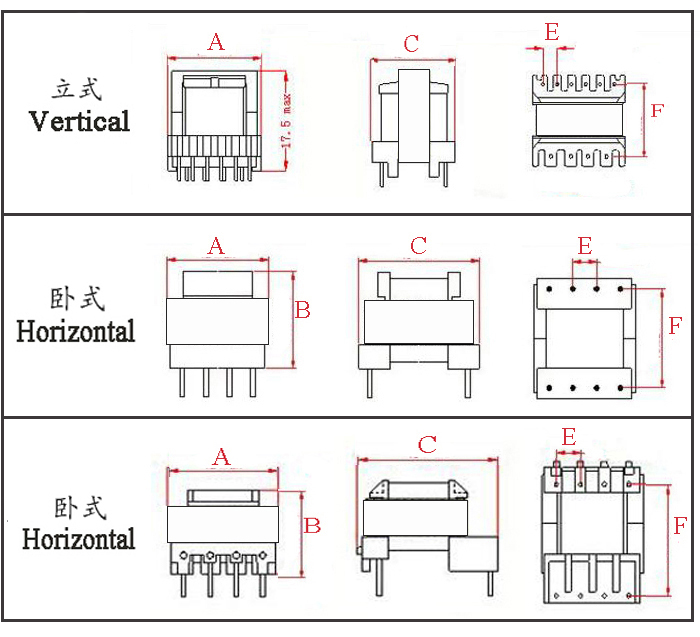
Type | Structure
Tурe | Dimension(mm) | Pin Row (mm) | Row Pitch(mm) | OD Pin(mm) | note | A | B | C | Pin | E | F | EE16-001 | Vertical | 16.5 | 12.5 | 15.0 | 3+3 | 3.0 | 9.0 | Φ0.60 |
| EE16-002 | Vertical | 16.5 | 13.1 | 18.0 | 5+5 | 3.2 | 10.6 | SQ0.50*0.50 |
| EE16-003 | Vertical | 16.5 | 12.5 | 15.0 | 2+2 | 9.0 | 9.6 | Φ0.60 |
| EE16-004 | Horizontal | 19.5 | 18.5 | 16.5 | 6+4 | 3.20+3.50 | 15.5 | Φ0.80 |
| EE16-005 | Horizontal | 16.5 | 15.0 | 14.5 | 4+4 | 3.0 | 11.0 | Φ0.60 |
| EE16-006 | Horizontal | 16.5 | 16.0 | 14.5 | 5+5 | 2.5 | 13.0 | Φ0.60 |
| EE16-007 | Horizontal | 16.5 | 19.0 | 13.5 | 5+5 | 2.5 | 15.5 | Φ0.70 |
| EE16-008 | Horizontal | 16.5 | 16.0 | 12.0 | 6+6 | 2.5 | 12.5 | Φ0.50 |
| EE16-009 | Vertical | 19.0 | 16.0 | 16.5 | 6+4 | 2.70/3.50 | 12.5 | Φ0.60 |
|
*The above are commonly used skeleton styles for companies.,Other styles are not included.,Inquiries are welcome. Our company can customize high-frequency transformers of various specifications according to customer requirements.
EE16 Transformer. The "EE" here refers to the core structure formed by pairing two "E"-shaped cores. The "16" indicates that the A dimension (external span, A = 16mm) of the core is 16mm. A complete EE16 core typically also includes key parameters such as the center leg cross-sectional area and window area.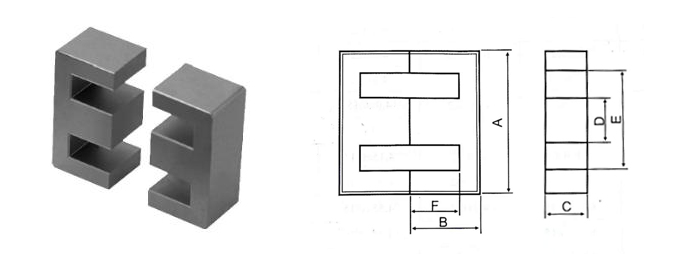
Electrical Performance of the EE16 Transformer The core electrical performance is determined jointly by the core parameters, winding design, topology suitability, and insulation safety. The following sections elaborate on key parameters, performance influencing factors, typical applications, and optimization approaches, providing reference for both design and selection. I. Core Electrical Performance Parameters (Baseline: PC40 ferrite, 100kHz, flyback topology)
Parameter Category | Key Indicator | Typical Value/Range | Description | Fundamental Electromagnetic | Inductance (L) | 100μH – 5mH | Varies with turns, air gap, AL value. Tolerance ±5%–±10%. | Leakage Inductance (Lk) | 2% – 5% of L | The smaller the better. Impacts EMI and voltage spikes. | DC Resistance (DCR) | Primary: 0.5–5Ω | Depends on wire gauge and turns. Affects copper loss. | Secondary: 0.1–2Ω | Losses & Efficiency | Core Loss (Pc) | 50 – 200 mW | Increases with frequency/flux density. PC40 better than generic materials. | Copper Loss (Pcu) | 100 – 500 mW | Increases with current density & frequency. Multi-strand wires can reduce. | Efficiency (η) | 85% – 92% | Lower at light load, higher at full load. Topology has significant impact (Flyback < Forward/LLC). | Safety & Insulation | Isolation Withstand Voltage | Primary-Secondary: 1.5 – 3kV AC / 1 min | Safety standard requirement. Depends on creepage distance and insulation material. | Insulation Resistance | ≥100 MΩ (500VDC) | Reflects insulation integrity. Decreases if damp. | Thermal & Endurance | Operating Frequency | 20kHz – 500kHz | Ferrite suitable for high frequency. Prone to saturation at low frequency. | Output Power | 0.5 – 15 W | Depends on topology, heat dissipation, duty cycle. | Operating Temperature | -40°C ~ +125°C | Limited by core and enameled wire temperature rating. |
II. Performance Influencing Factors and Mechanisms
Determinative Role of Core Parameters
External Span A=16mm determines the core window area (Aw) and effective cross-sectional area (Ae), directly influencing power capacity and saturation current. Larger Ae allows higher power handling at the same flux density.
Air Gap is core for controlling inductance and anti-saturation: Increased air gap → L decreases, saturation current increases, leakage inductance slightly increases. Non-uniform air gap causes permeability distribution deviation, leading to inductance fluctuation and thermal hot spots.
Material Grade: PC40 suitable for 100–200kHz, 3C90 suitable for 200–500kHz. 3C90 has lower core loss at high temperatures.
Key Influence of Winding Design
Number of Turns & Wire Gauge: Turns↑ → L↑, DCR↑, Pcu↑. Wire gauge↑ → DCR↓, Pcu↓, but window utilization is constrained.
Winding Process: Tight, layered winding reduces leakage inductance and distributed capacitance. Multi-strand enameled wire (Litz wire) suppresses skin effect, reducing high-frequency copper loss.
Insulation & Creepage: Bobbin slot width and barrier height determine isolation withstand voltage. Must comply with standards like UL62368-1/IEC 61558. Primary-Secondary creepage ≥3mm.
Compatibility with Topology & Operating Conditions
Flyback: Simple structure, low cost, but high leakage inductance, moderate efficiency. Suitable for low power <10W. Requires air gap for anti-saturation; snubber circuit is essential.
Forward / LLC: Low leakage inductance, high efficiency (LLC can reach 95%). Suitable for medium power 10–15W. LLC requires precise resonant parameter matching and high inductance consistency.
Duty Cycle & Flux Density: D ≤ 0.5 reduces saturation risk. Flux density Bm≤ 0.2T (at 100kHz) helps control core loss.
III. Typical Applications & Performance
Consumer Electronics: Mobile phone chargers, LED drivers (3–10W). Prioritizes flyback topology, pursues miniaturization and low cost. Efficiency target >88%.
Industrial Control: Sensor power supplies, low-power modules (1–5W). Emphasizes insulation and stability. Leakage inductance <3%, withstand voltage ≥2kV.
Lighting Power Supplies: LED constant current drivers (0.5–5W). Requires low ripple, high Power Factor. Inductance accuracy within ±5%.
IV. Performance Optimization Directions
Core & Air Gap Optimization: Select core with matching Ae based on power. Use grinding for air gap control (0.1–0.5mm), ensuring uniformity. Use low-loss materials (e.g., PC44, 3C90) to reduce core loss.
Winding Optimization: Use 0.1–0.2mm multi-strand Litz wire for high frequencies. Add shield layer between primary-secondary to reduce leakage inductance to 1%–2% of L. Use layered winding to reduce distributed capacitance.
Thermal & EMI Control: Control temperature rise ≤40°C, core loss density <200mW/cm³. Add RC/DVD snubber circuits and pair with common mode chokes to suppress EMI.
Safety Standards Compliance: Ensure creepage distance ≥3mm. Use Class B (130°C) or higher insulation materials. Perform withstand voltage tests by batch.
V. Selection & Design Key Points
Use AP Method for Preliminary Selection: AP = Ae × Aw. For flyback, use K=0.014, current density J=4–6A/mm², efficiency η=0.85. Ensure power matches heat dissipation.
Prioritize checking manufacturer datasheet for AL value, Le, Ae. Calculate turns N = √(L × Le / (μ₀ × μᵣ × Ae)). Adjust air gap based on target L.
Prototype Testing: Must test L, Lk, DCR, withstand voltage, insulation resistance. Retest stability under high temperature (85°C) and full load conditions.
Core Characteristics and Advantages of the EE16 Transformer The EE16 transformer (external span A=16mm) is a low-power high-frequency transformer. Its core characteristics center on compact size, high-frequency compatibility, and controlled cost. It is widely used in consumer electronics and small power modules. The specific characteristics are as follows:
Compact Size, High Space Utilization
With an external span of only 16mm, a short axis (width) typically between 7–8mm, and a height of 5–6mm, it falls under the miniature core specification. When paired with a dedicated bobbin, its overall volume is very small, making it ideal for space-constrained applications like mobile phone chargers, LED driver power supplies, and small sensor modules.
Good High-Frequency Compatibility, Moderate Efficiency
Typically paired with ferrite materials like PC40 or 3C90, its operating frequency covers 20kHz–500kHz, allowing it to match the high-frequency trend of switching power supplies. Within the 0.5–15W power range, efficiency can reach 85%–92%. When using an LLC topology or Litz wire winding, high-frequency losses are further reduced, and efficiency can be improved.
Accurate Power Coverage, Targeting Low-Power Scenarios
Its effective cross-sectional area (Ae) and window area (Aw) match low-power requirements. Typical output power is concentrated in the 3–10W range, making it the mainstream choice for mobile phone fast chargers, small appliance control boards, and security device power supply modules. It becomes limited in high-power scenarios due to core saturation and excessive losses.
Mature Process, Significant Cost Advantage
The EE16 is a standardized core model with mature tooling and winding processes and a well-developed supply chain. Components like bobbins and enameled wire are easy to procure, resulting in low mass-production costs. It is suitable for cost-sensitive consumer electronic products.
Easy Compliance with Insulation and Safety Standards
The barrier design of the core and bobbin can meet the requirement of ≥3mm creepage distance between primary and secondary. Simple insulation treatments (like adding insulation tape, using flame-retardant bobbins) enable compliance with safety standards such as UL62368-1 and IEC 61558, adapting it to isolated power supply needs.
High Flexibility, Performance Can Be Optimized as Needed
Adjusting the air gap (0.1–0.5mm) controls inductance and saturation current, meeting the needs of different topologies (flyback / forward).
Using layered winding or adding a shield layer can reduce leakage inductance (down to 1%–2% of the inductance value), minimizing EMI interference.
Changing core material (e.g., PC44 instead of PC40) improves stability in high-temperature environments.
Clear Limitations, Unsuitable for High-Power / Low-Frequency Scenarios
Limited by core size, when power exceeds 15W, core and copper losses increase sharply, leading to excessive temperature rise. In low-frequency operation (<20kHz), core saturation is prone to occur, making it unsuitable for line-frequency power supplies or high-power modules.
Applications of the EE16 Transformer Leveraging its small size, high-frequency compatibility, and low cost, the EE16 transformer primarily focuses on low-power (0.5–15W) isolated/non-isolated power supply scenarios. It is a mainstream choice in consumer electronics, smart home systems, industrial control, and other fields. Specific applications are as follows:
Consumer Electronics Power Supply Modules
Mobile Phone Chargers / Power Banks: Suitable for fast-charge specifications like 5V/2A, 9V/2A. Its compact size meets the miniaturization design needs of chargers. The flyback topology solution is mature, enabling controllable mass-production costs.
Small Digital Devices: Power boards for Bluetooth earbud charging cases, smartwatch chargers, and portable speakers, utilizing its miniaturization advantage to achieve slim and lightweight product designs.
LED Lighting Driver Power Supplies
Constant-current driver modules for household LED bulbs, light strips, and panel lights. With a power coverage of 3–10W, they precisely match the voltage/current requirements of low-power LEDs while meeting the safety standard requirements for isolation withstand voltage (1.5–3kV).
Power supply modules for automotive LED ambient lights and outdoor portable LED lights. Their temperature tolerance range (-40°C ~ +125°C) suits automotive and outdoor environments.
Smart Home & Security Devices
Power supply units for smart sockets, temperature/humidity sensors, and door/window alarms, providing stable low voltage DC power for control chips and wireless communication modules, offering both electrical isolation and noise immunity.
Power boards for surveillance cameras (indoor mini models) and smoke detectors. Their small size allows embedding into device housings, and the high-frequency operating mode reduces standby power consumption.
Industrial Control & Instrumentation
Auxiliary power supplies for small PLC modules and sensors (e.g., pressure sensors, proximity sensors), providing isolated power for control circuits to avoid strong electrical interference with signals.
Internal power conversion units for portable multimeters and small testing instruments. Their high efficiency helps extend device battery life.
Automotive Electronics Low-Power Modules
Power sections for in-vehicle USB fast-charge interfaces (low-power models), ambient light controllers, and tire pressure monitoring sensors. They adapt to the voltage conversion needs from the vehicle's 12V system to 5V/3.3V.
|


