* Product Parameters
Operating frequency:10kHz-500KHz Operating temperature:-40℃ to +125℃ Storage temperature:-25℃ to +85℃ Storage humidity:30 to 95%
* Features The EE19 transformer, thanks to itsSmall size, low cost, and moderate power densityIts characteristics have made it a core component in small and medium power switching power supplies for consumer electronics and industrial control. Its application design revolves around its core electrical parameters, aiming to achieve high efficiency and reliability.Reliable and compact energy conversion.
* Typical application areas Consumer electronics and home appliances (the largest application) Industrial Control and Automation Communication and network equipment LED lighting driver Computers and Office Equipment Automotive electronics (specific area)
* Product Standards UL, RoHS, 3C,CQC * Size Specifications 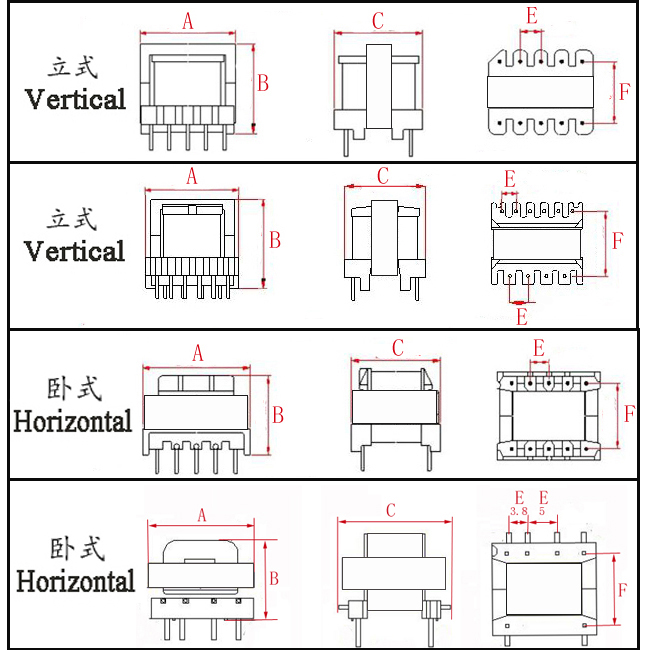
model | Structure type | size(mm) | Number of stitches | Stitch pitch (mm) | Row spacing (mm) | Acupuncture
mm | Remark | A | B | C | Pin | AND | F | EE19-001 | Vertical | 19.5 | 14.0 | 16.0 | 3+3 | 5.0 | 11.0 | Φ0.70 |
| EE19-002 | Vertical | 22.0 | 16.0 | 19.0 | 5+5 | 4.0 | 10.0 | Φ0.80 |
| EE19-003 | Vertical | 19.5 | 14.0 | 16.0 | 2+2 | 8.0 | 9.6 | Φ0.70 |
| EE19-004 | Vertical | 19.5 | 14.0 | 17.0 | 4+4 | 4.0 | 11.0 | Φ0.70 |
| EE19-005 | Vertical | 19.5 | 15.7 | 19.0 | 6+4 | 2.70/3.50 | 12.1 | Φ0.60 |
| EE19-006 | Horizontal | 19.5 | 16.3 | 12.5 | 4+4 | 4.8 | 12.8 | Φ0.70 |
| EE19-007 | Horizontal | 19.5 | 17.3 | 12.5 | 5+5 | 3.0 | 12.5 | Φ0.70 |
| EE19-008 | Horizontal | 19.5 | 17.4 | 11.1 | 6+4 | 2.5/7.5 | 14.2 | SQ0.40*0.60 | 4groove | EE19-009 | Horizontal | 19.5 | 16.0 | 14.8 | 4+4 | 4.8 | 12.5 | Φ0.70 | Dual slot |
The above are commonly used skeleton styles for companies.,Other styles are not included.,Inquiries are welcome. Our company can customize high-frequency transformers of various specifications according to customer requirements.
EE19 Transformer Electrical Performance Overview The electrical performance of an EE19 transformer is determined by the magnetic core material characteristics, winding design, topology compatibility, and insulation safety standards. Compared to the smaller EE16 model, the EE19 offers a larger effective cross-sectional area (Ae) and window area (Aw), providing enhanced power-handling capability in the low to medium power range and broader application scenarios. This article provides a detailed analysis of its core performance parameters, influencing mechanisms, typical applications, and optimization approaches.
I. Core Electrical Performance Parameters (Reference Conditions: PC40 ferrite core, 100kHz frequency, flyback topology) Parameter Category | Key Indicator | Typical Value/Range | Description | Basic Electromagnetism | Inductance (L) | 200μH–10mH | Determined by core AL value, winding turns and air gap size; tolerance is ±5%~±10% | Leakage Inductance (Lk) | 1%–3% of L | Lower than EE16 under the same winding process, which is beneficial to reduce voltage spikes and EMI interference | DC Resistance (DCR) | Primary: 0.3–4Ω; Secondary: 0.08–1.5Ω | Related to wire diameter, turns and winding density; reasonable wire selection can balance copper loss and window utilization | Loss & Efficiency | Core Loss (Pc) | 80–300mW | Increases with frequency and magnetic flux density; using 3C90 material can reduce core loss by 20%–30% at high frequency | Copper Loss (Pc) | 150–600mW | Affected by current density and skin effect; litz wire is recommended for frequencies above 200kHz | Efficiency (η) | 88%–94% | Higher than EE16 under the same power level; LLC topology can achieve efficiency over 93% | Safety & Insulation | Isolation Withstand Voltage | Primary-secondary: 2–4kV AC/1min | Meet UL62368-1/IEC 61558 standards; creepage distance ≥4mm can be achieved by optimizing skeleton structure | Insulation Resistance | ≥200MΩ (500VDC) | Has better moisture resistance than small-size cores; suitable for harsh environments with high humidity | Thermal & Endurance | Operating Frequency | 15kHz–500kHz | Wider frequency adaptation range; low-frequency performance is better than EE16 and not easy to saturate | Output Power | 5–30W | Power range is significantly higher than EE16; can reach 35W under forced air cooling | Operating Temperature | -40℃~+130℃ | Compatible with Class B (130℃) and Class F (155℃) insulation systems; core temperature rise is controlled within 45℃ under full load |
II. Key Factors Influencing Performance
Core Characteristics Form the Performance Foundation
The outer leg spacing A=19mm defines the overall core size. Compared to EE16, EE19’s effective cross‑sectional area (Ae) is about 30%–40% larger, directly enhancing flux‑carrying capacity and reducing core saturation risk under high current. The larger window area (Aw) allows the use of thicker wire or more turns, meeting both low DCR and high inductance requirements.
Air‑gap Design: The optimal air‑gap range for EE19 is 0.2–0.8mm. Increasing the air gap raises the saturation current (Isat) but slightly increases leakage inductance. Forward topologies require uniform air gaps to ensure symmetrical flux variation, while flyback topologies can use a properly designed gap to limit primary peak current.
Material Selection: PC40 is suitable for 50–200kHz applications, offering a good cost‑performance balance; 3C90 is preferred for 200–500kHz high‑frequency scenarios, providing lower core loss; for high‑temperature environments, materials such as N87 ensure stable performance up to 120℃.
Winding Design Directly Affects Losses and Stability
Turns Ratio and Wire Gauge: The turns ratio determines the voltage conversion ratio. Increasing wire diameter reduces DCR and copper loss but occupies more window space. For 10–20W supplies, primary wire is typically 0.2–0.4mm, secondary wire 0.4–0.8mm (adjustable based on output current).
Winding Technique: Using a “primary‑secondary‑primary” layered winding reduces leakage inductance and distributed capacitance. Adding a copper‑foil shield between primary and secondary windings effectively suppresses EMI. For high‑frequency operation, Litz wire with strand diameters of 0.05–0.1mm can reduce skin and proximity effects, lowering high‑frequency copper loss by 15%–25%.
Insulation Design: Bobbin barrier height should be ≥5mm, and primary‑secondary creepage distance ≥4mm. Using double‑insulated wire or inter‑layer insulation tape meets high isolation voltage requirements.
Topology Matching Impacts Efficiency and Reliability
Flyback Topology: Suitable for 5–15W supplies, simple and cost‑effective. EE19’s larger Ae reduces flux density, yielding 2%–3% lower core loss and higher efficiency compared to EE16 at the same power level.
Forward Topology: Suitable for 15–30W supplies, offering low output ripple and high stability. Requires a reset winding, and the core air gap should be minimized to ensure proper flux reset.
LLC Resonant Topology: Ideal for 20–35W high‑efficiency applications, with efficiency exceeding 93%. Requires precise matching of inductance and capacitance parameters; EE19’s low leakage inductance favors resonant operation.
Operating Conditions Affect Long‑Term Performance
Frequency: Core loss is proportional to the square of the frequency. For frequencies above 300kHz, low‑loss materials such as 3C90 are recommended.
Temperature: High temperature reduces core permeability and increases losses. The core operating temperature should not exceed the Curie temperature (about 210℃ for PC40).
Load Rate: Efficiency peaks at 60%–80% load. At light loads (below 20%), standby loss dominates, reducing overall efficiency.
III. Typical Applications With its balanced performance and cost advantages, the EE19 transformer is widely used in 5–30W isolated power supplies for:
Consumer Electronics: Fast‑chargers for tablets and laptops (15–30W), power modules for small appliances like electric toothbrushes and mini‑fans.
LED Lighting: LED panel lights, downlight drivers (10–25W), meeting requirements for high power factor and low harmonic current.
Industrial Control: PLC module and inverter auxiliary power supplies (5–15W), offering strong noise immunity and high operational stability.
Automotive Electronics: Car chargers (10–30W), LED headlamp drivers, capable of stable operation over -40℃ to +125℃.
IV. Performance Optimization Recommendations
Material Optimization: Use 3C90 instead of PC40 for high‑frequency applications to reduce core loss; select N87 for high‑temperature environments.
Winding Optimization: Employ Litz wire for high‑frequency operation; adopt layered winding with shielding to reduce leakage inductance and EMI.
Thermal Optimization: Enhance thermal design, e.g., attach the core to a heatsink with thermal adhesive, keeping temperature rise below 40℃.
Parameter Matching: Adjust air gap and turns ratio according to the topology to achieve an optimal balance of efficiency and stability.
The EE19 transformer (with an outer span A-dimension of 19mm) is a low-to-medium power high-frequency transformer. Compared with smaller models such as the EE16, it features balanced performance and a wide range of applicable scenarios, thanks to its larger core volume and optimized electromagnetic structure. The specific characteristics are as follows: 1. Stronger Power Handling Capacity The 19mm outer span provides a larger effective cross-sectional area (Ae) and window area (Aw). Compared with the EE16, its power coverage is extended to 5–30W (up to 35W under forced air cooling), which can meet the power supply needs of medium-power equipment such as tablet fast chargers,LED panel lights, and small industrial modules. It avoids the saturation and overheating issues of small cores under high-power operating conditions. 2.Wide High-Frequency Adaptability & Higher Efficiency When paired with ferrite materials such as PC40, 3C90, and N87, it has an operating frequency range of 15kHz–500kHz. Its low-frequency performance is superior to that of the EE16, and it is less prone to core saturation. Under the same power level, its efficiency can reach 88%–94%; when using the LLC resonant topology, the efficiency can exceed 93%. Moreover, its leakage inductance is only 1%–3% of the inductance, which greatly reduces voltage spikes and EMI interference. 3.Superior Insulation & Stability The structural design of the core and bobbin can easily meet the requirement of a primary-secondary creepage distance of ≥4mm, with an isolation withstand voltage of 2–4kV AC/1min, complying with safety standards such as UL62368-1 and IEC 61558. The insulation resistance is ≥200MΩ (500VDC), offering better moisture resistance and adapting to harsh working conditions with high humidity and a temperature range of -40℃~+130℃. 4.Good Topology Compatibility & Flexible Design It is compatible with mainstream topologies including flyback, forward, and LLC resonance: The flyback topology is suitable for 5–15W low-cost solutions; The forward topology meets the low-ripple requirements of 15–30W applications; The LLC topology achieves high-efficiency output of 20–35W. By adjusting the air gap within the range of 0.2-0.8mm, the inductance and saturation current can be precisely controlled to match the parameter requirements of different topologies.
5.Clear Limitations Restricted by the core size, when the power exceeds 35W, the core loss and copper loss will increase sharply, making temperature rise difficult to control. It is not suitable for power frequency (50/60Hz) power supply scenarios, as the core loss is excessively high at low frequencies, resulting in extremely low energy efficiency.
Applications of EE19 TransformerWith the characteristics of 5–30W low-to medium power coverage, high efficiency and wide frequency adaptability, the EE19 transformer is widely used in consumer electronics, LED lighting, industrial control, automotive electronics and other fields. The specific application scenarios are as follows: Power Supply Modules for Consumer Electronics 15–30W fast charging power supplies for tablets and thin-and-light laptops, as well as power boards for small household appliances such as electric toothbrushes, fascia guns and small humidifiers. It balances compact size and stable output, meeting the portability design requirements of devices. Auxiliary power supplies for set-top boxes and routers, which can work stably under wide voltage input with low standby power consumption.
LED Lighting Driver Power Supplies Constant current driver modules for 10–25W LED panel lights, downlights and ceiling lights. It can meet the safety requirements of high power factor and low harmonics, suitable for household and commercial lighting scenarios. Driver power supplies for outdoor waterproof LED strips and garden lights. Its temperature resistance range (-40℃~+130℃) can adapt to the large temperature difference of outdoor environments.
Industrial Control and Instrumentation Auxiliary isolated power supplies for small PLC modules and sensors (such as temperature and humidity sensors, pressure sensors). It provides stable low-voltage power for control circuits with strong antielectromagnetic interference capability, preventing strong electric signals from intruding. Built-in power conversion units for portable testing instruments and handheld terminals. Its high efficiency characteristic can extend the battery life of devices.
Low-Power Systems for Automotive Electronics Power supply parts of 15–30W vehicle-mounted USB fast charging ports, vehicle-mounted ambient light controllers and tire pressure monitoring modules. It can adapt to 12V/24V vehicle-mounted power input and stably realize voltage conversion. Power supply modules for vehicle-mounted air purifiers and small car refrigerators, meeting the vibration resistance and wide temperature requirements of vehicle-mounted environments.
Smart Home Devices Power supply units for smart door locks, camera pan-tilts and whole-house smart central control screens. Its moderate size allows it to be embedded inside the device, and its isolation withstand voltage performance ensures electricity safety. Power supply modules for household security alarms and smoke sensors. Its low standby power consumption meets the energy-saving needs of smart homes.
|


