* Product Parameters
Operating frequency:10kHz-500KHz Operating temperature:-40℃ to +125℃ Storage temperature:-25℃ to +85℃ Storage humidity:30 to 95%
* Features The EE22 transformer is aCompact, low-cost, and suitable for medium- to high-frequency (20kHz-200kHz) small-power general-purpose transformers in the 10W-30W range.All its features stem from the standard geometry of the EE22 magnetic core and the commonly used ferrite materials.
* Typical application areas AC/DC switching power adapter12W, 18W, 24W and other mobile phone/router chargers, and external power supplies for low-power devices. Auxiliary power supply (Standby Power)In large equipment, it provides standby power for control chips, fans, etc. DC/DC module power supplyIsolated low-voltage, low-power DC-DC converter module. LED driver power supply: Small to medium power constant current LED driver.
* Product Standards UL, RoHS, 3C,CQC
* Size Specifications 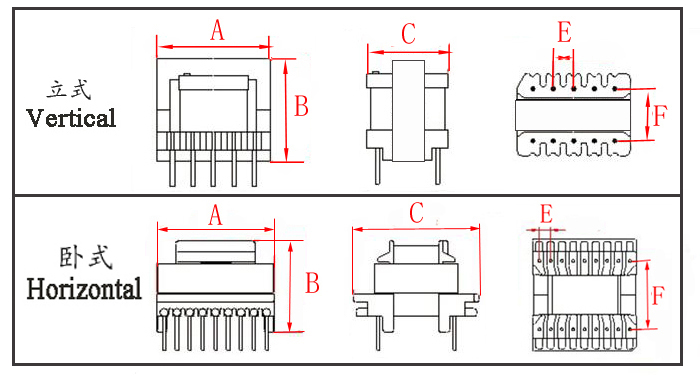
Type | Structure
Tурe | Dimension(mm) | Pin Row (mm) | Row Pitch(mm) | OD Pin(mm) | note | A | B | C | Pin | E | F | EE22-001 | Vertical | 23.0 | 16.0 | 23.0 | 5+5 | 4.0 | 10.0 | Φ0.80 |
| EE22-002 | Horizontal | 23.0 | 16.0 | 13.2 | 4+4 | 4.25/4.80 | 13.0 | Φ0.70 |
| EE22-003 | Horizontal | 23.0 | 22.5 | 20.5 | 5+4 | 4.00/5.00 | 17.0 | Φ0.60 |
|
*The above are commonly used skeleton styles for the company.,Other styles are not included.,Inquiries are welcome. Our company can customize various specifications according to customer requirements.High-frequency transformer.
EE22 Transformer Electrical Performance Explanation The EE22 transformer (external span A=22mm) is a medium-power high-frequency transformer. Compared to EE16 and EE19 types, its core effective cross-sectional area (Ae) and window area (Aw) are further increased, leading to significant improvements in power handling capability and thermal stability. Its core electrical performance is determined by the magnetic core material, winding technique, and topology matching. It is suitable for 20–60W medium-power supply scenarios. The following analysis covers core parameters, performance influencing factors, typical applications, and optimization directions. I. Core Electrical Performance Parameters (Baseline Conditions: PC44 ferrite, 100kHz, Forward topology) Parameter Category | Key Indicators | Typical Value / Range | Explanation | Basic Electromagnetic Parameters | Inductance (L) | 500μH–20mH | Determined by core AL value, number of turns, and air gap; tolerance ±3% to ±8%; air gap offers a broader adjustment range for inductance. | Leakage Inductance (Lk) | 0.8%–2% of L | With identical winding technique, leakage inductance is lower than EE19, significantly reducing voltage spikes and EMI filtering costs. | DC Resistance (DCR) | Primary: 0.2–3Ω; Secondary: 0.05–1Ω | Ample room for wire gauge selection; copper loss can be further reduced using thicker wire. | Loss & Efficiency | Core Loss (Pc) | 150–500mW | Increases with frequency and flux density; using 3C94 material reduces high-frequency core loss by over 30% compared to PC44. | Copper Loss (Pcu) | 200–800mW | Affected by current density and winding density; Litz wire can effectively suppress high-frequency losses above 200kHz. | Efficiency (η) | 90%–96% | Higher efficiency than EE19 at equivalent power; efficiency can exceed 95% in LLC topology. | Safety & Insulation | Isolation Withstand Voltage | Primary-Secondary: 3–5kV AC/1min | Bobbin barrier height ≥6mm, creepage distance ≥5mm, meeting medical/industrial safety standard requirements. | Insulation Resistance | ≥500MΩ (500VDC) | Excellent moisture resistance, adaptable to high-humidity industrial environments. | Thermal Performance & Endurance | Operating Frequency | 10kHz–500kHz | Lower risk of saturation at low frequencies, covering power frequency critical ranges and high-frequency switching power supply scenarios. | Output Power | 20–60W | Up to 50W with natural convection cooling; upper limit increases to 70W with forced air cooling. | Operating Temperature | -40℃ to +150℃ | Compatible with Class F (155℃) and Class H (180℃) insulation systems; full-load temperature rise ≤50℃. |
II. Key Factors Affecting Performance 1. Core Characteristics: The Core Support for Power and Stability Advantage of external span A=22mm: Effective cross-sectional area (Ae) increases by ~40–50% compared to EE19, providing stronger flux handling capability and reducing saturation risk under high current conditions. The increased window area (Aw) allows for more turns and/or thicker wire simultaneously, meeting design needs for both high inductance and low copper loss. Air Gap Design: Optimal air gap range is 0.3–1.0mm.
Forward Topology: Requires minimal air gap (0.3–0.5mm) to ensure core reset.
Flyback Topology: Air gap can be increased (0.6–1.0mm) to boost saturation current.
LLC Topology: Requires precise air gap control to ensure matching between magnetizing inductance and resonant parameters.
Material Selection:
PC44: Suitable for 50–200kHz, cost-effective, ideal for consumer electronics and industrial power supplies.
3C94: Suitable for high-frequency (200–500kHz) scenarios, outstanding low-loss characteristics.
N87: Suitable for high-temperature (above 120℃) industrial environments, offers strong permeability stability.
2. Winding Design: The Key to Loss Control Turns Ratio & Wire Gauge: The turns ratio determines the voltage conversion ratio. For 20–60W supplies, primary wire diameter is recommended at 0.3–0.6mm, secondary at 0.6–1.2mm (adjusted based on output current). For high output current, the secondary can use multiple strands in parallel to reduce skin effect. Winding Technique: Using interleaved winding (e.g., primary-secondary-primary-secondary) further reduces leakage inductance. Adding a double-layer copper foil shield between primary and secondary, which is grounded, can significantly suppress common-mode interference. For high-frequency operation, use Litz wire with strand diameters of 0.08–0.15mm, which can reduce high-frequency copper loss by 20–30%. Insulation Design: Use Nomex paper or polyimide tape for inter-layer insulation. Creepage distance between primary and secondary should be ≥5mm to meet standards like UL60601 (medical) or UL508 (industrial). 3. Topology Matching: Core to Efficiency and Reliability
Forward Topology: Suitable for 30–60W supplies, offers low output ripple and strong load capability. Requires a reset winding or active clamp circuit. The large Ae of EE22 helps reduce flux density, decreasing core loss.
LLC Resonant Topology: Suitable for 40–70W high-efficiency supplies, efficiency can exceed 95%. The low leakage inductance characteristic of EE22 helps reduce resonant losses and improve system stability.
Flyback Topology: Suitable for 20–30W cost-sensitive solutions. Compared to EE19, it can reduce turns count (lowering copper loss) while improving overload capability.
4. Operating Conditions: Ensuring Long-term Stable Operation
Frequency: Core loss is proportional to the square of frequency. When frequency exceeds 300kHz, prioritize low-loss materials like 3C94 or N87.
Temperature: High temperature reduces permeability and increases losses. Ensure core temperature does not exceed the material's Curie temperature (~210℃ for PC44). Applying thermal adhesive to bond the core to a heatsink can reduce temperature rise by 10–15℃.
Load Rate: Optimal efficiency typically occurs at 70–90% load. Under light load (<20%), standby loss can be reduced by optimizing winding distributed capacitance.
III. Typical Application Scenarios The EE22 transformer, with its medium power handling and high stability, is widely used in:
Consumer Electronics: Laptop adapters (45–60W), 20V fast-charge power supplies, small energy storage power modules, balancing efficiency and size.
Industrial Control: PLC main unit power supplies, servo drive auxiliary power supplies, industrial sensor power modules, meeting requirements for wide-temperature and high-insulation industrial environments.
LED Lighting:30-50W commercial LED spotlights, panel light driver power supplies, supporting high power factor (PF≥0.95) and low harmonic distortion (THD≤10%).
Medical Electronics: Power supplies for portable medical devices (e.g., blood pressure monitors, glucose meters), meeting medical-grade isolation withstand voltage and low leakage current requirements.
Automotive Electronics: Automotive inverters (50–60W), car refrigerator power supplies, adapted to the wide automotive temperature range of -40℃ to +125℃.
IV. Performance Optimization Suggestions
Material Optimization: Use 3C94 instead of PC44 for high-frequency scenarios; choose N87 for high-temperature scenarios; standard PC40 can be used for cost-sensitive applications.
Winding Optimization: Mandate the use of Litz wire for high-frequency operation. Employ interleaved winding + copper foil shielding to control leakage inductance within 1% of the inductance value.
Thermal Optimization: Apply thermal grease on the core surface and attach an aluminum heatsink. Design ventilation holes in the power supply enclosure to improve natural convection cooling efficiency.
Parameter Matching: Adjust air gap and turns ratio according to the topology: prioritize minimizing air gap for Forward topology; prioritize ensuring magnetizing inductance accuracy for LLC topology.
EE22 Transformer (External Span A=22mm) is a medium-power high-frequency transformer. Compared to smaller-size models like EE16 and EE19, its core volume, effective cross-sectional area (Ae), and window area (Aw) are further increased. This results in core performance characteristics of strong power handling capability, high efficiency, and excellent stability, as detailed below: Wide Power Coverage Range, Outstanding Power Handling Capability
Output power can reach 20–50W under natural convection cooling and increase to 70W with forced air cooling, representing over a 100% increase in the upper power limit compared to EE19.
The larger Ae significantly reduces the risk of core saturation under high-current conditions, making it directly suitable for the power supply needs of medium-power devices such as notebook adapters and small energy storage power supplies.
Strong High-Frequency Adaptability, Lower Losses & Higher Efficiency
Operating frequency range covers 10kHz to 500kHz. Saturation risk is far lower than with smaller cores at low frequencies. At high frequencies, when paired with low-loss materials like 3C94 or N87, core loss can be reduced by over 30%.
Overall efficiency reaches 90% to 96%, even exceeding 95% in LLC resonant topologies.
Leakage inductance is only 0.8% to 2% of the main inductance, substantially reducing voltage spikes and EMI interference.
Excellent Insulation & Stability, Suitable for Demanding Conditions
Bobbin barrier height ≥6mm, primary-secondary creepage distance ≥5mm, with isolation withstand voltage up to 3–5kV AC for 1 minute, meeting UL60601 (medical-grade) and UL508 (industrial-grade) safety standard requirements.
Insulation resistance ≥500MΩ (at 500VDC), featuring outstanding moisture resistance.
Capable of stable operation across a wide temperature range of -40℃ to +150℃, suitable for high-reliability scenarios like industrial and automotive applications.
Good Topology Compatibility, High Design Flexibility
Perfectly compatible with mainstream topologies like Flyback, Forward, and LLC Resonant:
Flyback topology suits 20–30W low-cost solutions.
Forward topology fits 30–60W applications requiring low ripple.
LLC topology achieves 40–70W high-efficiency output.
By adjusting the air gap within 0.3-1.0mm, inductance and saturation current can be precisely controlled to meet the parameter requirements of different topologies.
Ample Winding Design Space, Superior Loss Control
The larger window area allows for the use of thicker enameled wires or multiple parallel strands. Secondary wire diameter can reach 0.6–1.2mm, effectively reducing DC resistance and copper loss.
For high-frequency operation, pairing with Litz wire can further suppress the skin effect, reducing high-frequency copper loss by 20–30%.
Mature Manufacturing Process, Balanced Cost-Effectiveness
As a standardized medium-power core model, it benefits from a mature supply chain for molds and bobbins, ensuring controllable mass production costs.
Compared to larger transformers like EE25 and EE28, the EE22 meets medium-power requirements while balancing compact size and cost advantages, making it a cost-effective choice for the 20–70W power range.
Clear Limitations
When power exceeds 70W, core loss and copper loss increase sharply, making temperature rise difficult to control.
Not suitable for power frequency (50/60Hz) power supply applications, as core loss at low frequencies is excessively high, resulting in extremely poor energy efficiency.
EE22 Transformer Applications Leveraging its core advantages of medium-power coverage (20–70W), high efficiency, high stability, and wide-temperature adaptability, the EE22 transformer is widely used in various fields, including consumer electronics, industrial control, LED commercial lighting, medical electronics, and automotive electronics. Specific application scenarios are as follows: Consumer Electronics Power Modules
45–60W laptop adapters, 20V fast-charging power supplies, and small energy storage power supplies (such as extended-capacity portable power banks), balancing output power with device miniaturization. LLC topology solutions can achieve conversion efficiency exceeding 95%.
Low-power desktop PC power supplies and printer auxiliary power supply boards, where stable voltage output ensures prolonged device operation.
Industrial Control & Instrumentation
PLC main unit power supplies, servo drive auxiliary power supplies, and industrial sensor (e.g., flow sensors, load cells) power modules, meeting the wide-temperature requirements of industrial environments (-40℃ to +150℃). The 3–5kV isolation withstand voltage effectively resists strong electrical interference.
Built-in power supplies for portable industrial testers and data collectors, where high efficiency reduces device power consumption and extends battery life.
LED Commercial Lighting Drivers
Constant-current driver power supplies for 30–50W commercial LED spotlights, panel lights, and grid lights, supporting high power factor (PF ≥ 0.95) and low harmonic distortion (THD ≤ 10%), complying with energy-saving and safety standards for commercial lighting.
Driver modules for outdoor advertising light boxes and landscape LED light strips, where moisture-resistant and temperature-tolerant properties allow adaptation to harsh outdoor environments.
Medical Electronic Devices
Isolated power supplies for portable medical devices (such as electronic blood pressure monitors, glucose meters, and portable ECG monitors), meeting UL60601 medical-grade safety requirements. Low leakage current design ensures user safety.
Auxiliary power units for small medical instruments (such as desktop ultrasound devices and blood analyzers), where high stability prevents instrument data deviation.
Automotive Electronic Systems
50–60W automotive inverters (12V to 220V), small car refrigerator power supplies, and automotive air purifier power modules, capable of adapting to voltage fluctuations and vibration shocks in the automotive environment.
Power supply boards for automotive infotainment systems and high-power automotive chargers, where wide-temperature characteristics ensure stable operation under extreme conditions, from high-temperature exposure to severe cold.
|


